Seen at Steve Graham's forthcoming auction, a tray of Morse keys.
 From the Chateau's website.
What's interesting is what is coming out of the experiment already:Deep in the forests of central France, an unusual architectural experiment is half-way to completion, as a team of masons replicates in painstaking detail the construction of an entire medieval castle.
The Chateau de Guedelon was started in 1998, after local landowner Michel Guyot wondered whether it would be possible to build a castle from scratch, using only contemporary tools and materials.
Experts are fascinated by what the experiment can teach about medieval building methods.One example concerns lime kilns, used for making the mortar. Archaeologists had often wondered why they found traces of two separate kilns at construction sites.
Experience at Guedelon showed that, in a day's work, builders often needed to top up the mortar brought in from the main kiln with small amounts made close at hand. Hence the small second kiln actually inside the castle.
The discolouring of lime-based mortar is another revelation. Within one or two years of being laid, Guedelon's walls are already showing streaks of unsightly white where the lime is leaching.
Archaeologists think this is a clue to why medieval castles were very quickly plastered and painted: it was to hide the mess.

BBC
While currently it is being treated as an academically rigorous exercise, it started out as an 'eccentric pipe dream'. Also revealing is the need for a theoretical mediaeval 'owner' to centre the project around, rather than being able to run it as an abstract model. As one of the guides said:
"Funnily enough, we found that even though we knew we were being accurate, somehow the castle lacked soul. So we invented a character - the owner - who would have likes and dislikes, wanting this and not wanting that," says Ms Preston.So how cool is that? Certainly it would add a je ne sais... mais exactement to studying a castle in school.
 Bombed on the beaches, British soldiers use Lee Enfield rifles to fire back at the German Luftwaffe. (BBC.)
 Here in the Imperial War Museum, London, is one of the little ships of Dunkirk- in fact the littlest, Tamzine - sailed by amateur or professional civilian sailors that brought the soldiers off the beaches. Author.
Anzac Day is a national day of remembrance in Australia and New Zealand, and is commemorated by both countries on 25 April every year to honour members of the Australian and New Zealand Army Corps (ANZAC) who fought at Gallipoli in Turkey during World War I. It now more broadly commemorates all those who died and served in military operations for their countries. Anzac Day is also observed in the Cook Islands, Niue, Samoa and Tonga.Wikipedia.
It was lost on the night of bombardment before the first landing, lost in the first hour on the beach, lost on each of the two hundred and ninety-eight days that followed, lost in the planning at Whitehall, lost in the choice of the deranged Ian Hamilton, lost in the luck of getting the genius Ataturk as our principal foe.Bob Ellis
Rear Admiral Steve Gilmore, the commander of the Australian naval fleet told the thousands gathered at central Sydney's Cenotaph for Sunday's Anzac Day dawn service that Australia's national identity was established at Gallipoli.Rear Admiral Gilmore said the nation enjoys the freedoms it does thanks to the 1.8 million Australians who've served in military campaigns over the past 95 years.
Rear Admiral Gilmore said 102,000 Australian servicemen and servicewomen had made the ultimate sacrifice, and he asked that their contribution be remembered on this day.
"Because of Gallipoli our national identity was firmly established," he said, referring to Australia's best known military campaign.
Bob Ellis, ABC.
And many of us believed it, the audacious, denialist spin that a battle ill lost from which no good came was worth being in because it 'tested our mettle' and 'showed what game young men can do'.
Paul Keating, launching Graham Freudenberg's Churchill and Australia said Australia didn't have to prove anything. It already had the highest standard of living in the world, along with female suffrage, pensions, exemplary health care, a literate working class, good writers, athletes, musicians, painters, cartoonists. What was there to prove? That we could perish bravely in war, that great game of drongos?
'I have never gone to Gallipoli,' Keating said, 'and I never will. Kokoda is more my speed. There we fought, and won, a long battle that made a difference to our nation's future. That saved us from something, as Gallipoli never did.'
War historian and author Roland Perry told the service that despite the horrific losses of thousands of young diggers, Australia had had a huge impact on the world stage during World War I.
‘‘The Turks had ruled the Middle East for 400 years but the Anzacs did more than any other force to change the map of the Middle East roughly to where it is today,’’ he said.
‘‘In the four years... Australia had a remarkable impact on the world stage never to be repeated.
‘‘But we are here today to remember the men and women of Australia and New Zealand who sacrificed and served in all wars, not just the Great War.’’
What the Australians won at Gallipoli was huge respect, including from their enemy. It really is time we started making clear to young Australians that the Anzacs didn't die protecting Australia from being invaded. Rather, we were invading a country on the other side of the world - to wit, Turkey - with whom we had no difference as a people outside the larger politics of the day.Surely it is time we owed Turkey, and Turkish Australians, that respect. Look at the respect Turkey shows our dead.
I ask this question most seriously. Does any country in the world - other than Turkey - permit a people who tried to invade it to commemorate the fact of that attempted invasion on their shores each year? I know of not a single one. Imagine if the descendants of the Japanese pilots who bombed Darwin held an emotional service beneath the Japanese flag on the shores of Darwin Harbour each year.
Organisers were hoping for a record 40,000 people at the Shrine of Remembrance, ensuring Melbourne’s dawn service remains as powerful as ever - 95 years since Aussie diggers landed at Gallipoli.AAP, The Age
Trooper Mark Donaldson, who was awarded the Victoria Cross for services in Afghanistan, said it was vital young people take part in Anzac Day.
"You have to keep it alive because if you don't pass it down and make sure they understand what it's about then it's going to be forgotten about," Trooper Donaldson told reporters in Sydney following the march.
In 1983, when his yacht, Australia 2, won the America's Cup, owner Alan Bond acknowledged that at one stage his crew had been losing but added "it was just like Gallipoli, and we won that one".It would be interesting to know exactly how that comment was received in lounge rooms across Australia. Did it feel "right" to most who heard it? My guess is that it did.
Gallipoli was a military disaster. We should note that in justice to the young men who died there. Do we owe them less than we owe those who die in bushfires like Black Saturday? We should also note it in justice to future generations. The voices that urged Australia into the invasion of Iraq were of the same character as those that propelled Australia to Gallipoli in 1914.
Many young families, including bleary-eyed children, came to the service. Lynda Brown said her seven-year-old son Callum had an obsession with war history.
‘‘I have been here before and I thought it was a good for him to come along and hopefully get rid of the romanticism of war and hear some stories and see that some people are upset,’’ she said.
Propaganda was involved in shaping the popular view of Gallipoli from the start. Take the case of John Simpson Kirkpatrick, the man with the donkey. Within six weeks of his death, he had been conscripted into the propaganda war, a newspaper report describing him as ''a six-foot Australian'' with ''a woman's hands'' who said in a British-Australian accent, ''I'll take this fellow next.''
Simmo was a five-foot-eight Geordie with a stoker's hands who spoke in dialect and had fierce Labor politics. His first biographer, a fan of Churchill and acquaintance of Sir Robert Menzies, stripped him of his politics. There was no mention of boozing or fighting. The real Simmo was left in a grave at Gallipoli.
Too many of us have felt the effects, national and personal, of our nation's willingness to participate in foreign wars - because, as Australians, we bizarrely saw ourselves as foreign to our own homeland.
It is often claimed that our soldiers died for ''the freedom we enjoy today''. But to a sovereign nation, being truly free means being independent. Even as our monuments, ceremonies and memories of war endure, Australia is surely now mature enough to learn the lessons of its history and face the hard truths behind its myths.
Tony Wright, The Age.
The Gallipoli peninsula and its pocket-handkerchief of a weatherworn battlefield is the site of a defeat for Australian and New Zealand soldiers (not to mention the British, the French, the Senegalese, the Indians and others from a lost empire), and a defeat that occurred long before any of us who might make the trip now were born.
...
The band of would-be gypsies, each of them Australian, made it to the Anzac commemorative site well before dawn, found a tiny spot on the lawn, laid out their Turkish carpet and hunkered down among thousands of other travellers for the cold wait, a fingernail moon eventually sliding over the crags and ridges, the Aegean Sea silvering.
...
No other people travel in such great numbers over such distances to such a curious destination.
Martin Flanagan, The Age.
It was Ataturk who declared to the mothers of Australia that their sons lay in friendly soil. A group of about 80 Turkish Australians march each year in Melbourne on Anzac Day. Anzac Day would not be the same without them.
 Image by C-130 Hercules Flight Engineer Mark.
 Berliners watching a C-54 land at Berlin Tempelhof Airport, 1948. United States Air Force Historical Research Agency via Cees Steijger.
 Above: The ramp at Port au Prince Haiti. (US Defense. A high res version of the image is available here.) On this ramp area is a remarkable variety of aircraft. Some are familiar to us all from airports, others, like the US Coast Guard Hercules less so, and in the middle of the photo is an upright white tail between two grey ones. That's a C-54, one of the types used over half a century ago to save Berlin - as seen in the black and white image above.
I landed there last night. I unloaded 130,000 pounds of rolling stock and food. We expected to carry out 250+ passengers. We were told that no passengers were on site. While we were getting ready to leave, a guy ran up and asked how long we could wait. I checked with my pilots and told him we had about an hour. He said a bunch of passengers had just shown up unexpectedly and they wanted to put them with us. I told him to get me as many as they could. ...
 Brad Pilgrim.
  Radio operators in action in this uncaptioned Imperial War Museum image. (IWM)
 The Lancaster I NG128 dropping its load over Duisburg on Oct 14, 1944. The aircraft is carrying Airborne Cigar (ABC) radio jamming equipment, as shown by the two vertical aerials on the fuselage. (RAF Pathfinder Museum)
Then in October 1943 something quite different was introduced – 'Corona'. At Kingsdown, using those high power transmitters to reach far into enemy country, specially selected men and women began annoying voice interference on the 3–6 megacycle range. Pseudo controllers issued false tuning counts to prevent the Luftwaffe going operational, gave false fog warnings to get aircraft to land, read poetry, or relayed Hitler’s speeches to disrupt and frustrate, and gave direct, contrary orders to cause confusion.Sam Brooks (on the BBC 'People's War' website) remembers:
The Germans tried all manner of devices to overcome the jamming, including having their instructions sung by Wagnerian sopranos. This was to fool our operators into thinking it was just a civilian channel and not worth jamming.Back to Peggy:
Corona led to some amusing incidents. A German controller was trying to direct his aircraft to Kassel. Kingsdown’s 'ghost' was trying to stop them and told them not to take any notice of the Englander who was trying to confuse them. After an exchange or two, the German became pretty agitated, lost his temper, and swore. Our 'ghost' replied, “The Englander is now swearing” and was met by an infuriated shriek from Germany: “It's not the *%$#@$ Englander who is swearing, it's *%$#@$ me”!
 An 'atmospherically lit' Messerschmitt Bf 110 night fighter, one of the Luftwaffe's main types in the role, in the RAF Museum, Hendon. Author.
When a 101 Squadron Lancaster with its ABC 'Special' was shot down over Berlin, the Luftwaffe assumed Kingsdown’s 'Corona' voice interference came from that ABC equipment. They reasoned, correctly, that the RAF would not allow women to fly operationally over Germany and switched to women ground controllers. Since we had anticipated that, we did the same.
 An uncaptioned photograph of a woman operator - probably radar rather than radio - on the Imperial War Museum website. (IWM)
One of our girls got into a similar battle of wills, the only difference being that both women ended up laughing with each other and had to shut down. We all enjoyed the incident very much – but did wonder what happened to the lass over there!Such moments of bizarre amusement were few in such a terrible war, but who could ever have predicted such an event ever coming to pass?
 Nottingham Castle, 1990s.
 Omaka, NZ, 2007. " This one's bust."
 Warwick Castle, 1990s. Wallop.
 Warwick Castle.
 Nottingham Castle.
 But the Kiwis put on quite the show. Note the splintered lance below...
 Two above, Omaka, NZ.
SPECIAL
I'm down at last – through squelch
and patronising signs –
'Landowners Welcome Caring Walkers' –
to find him at the bus stop.
He 'likes my bonnet' (the
Ashes sunhat you gave me, Son)
and straight off I know he's military –
and the accent isn't Yorkshire –
'Canadian –
Army man – World War Two…'
'You must've been young!'
'Eighty-five. Work with young folks.'
As if that explains something!
I guess I must look…
interested, so the conversation…
lecture – let's be frank – it's
after all his job now: 'Historical Speaker on
Army Matters'… well, whatever it is, it
continues on the bus all the way down
to the grey-brown valley foot!
When he dings to alight, I've
heard about his First Special Force
experiences, seen his personal,
engraved medallion on a delicate
gold chain around his seasoned
neck, and we've agreed the kids
just need to be 'taken there
with words' and how you have to 'be
careful putting it right' –
they'll understand in time that
'sometimes questions can't
be answered': If Wilhelmina –
'Smart-arse kid, sometimes the girls
are just as bad…' asks
'Did you kill?' she gets to stand in for
the man who knows and
answer for him –
'Do you want to tell these kids you killed their…
father?'
'…No…'
'Brother…'
'…No…'
'Cousin?…'
'By the time I get to "Uncle" Wilhelmina's
usually in tears.
All that stuff's mine to know
and live with. Nobody knows –
not family, not friends…'
But as he tosses a jaunty salute
past the bus window from the pavement,
I know.
Ross Kightly
 Poppies in Oxfordshire. B&J.
 McCrae's pistol. J.
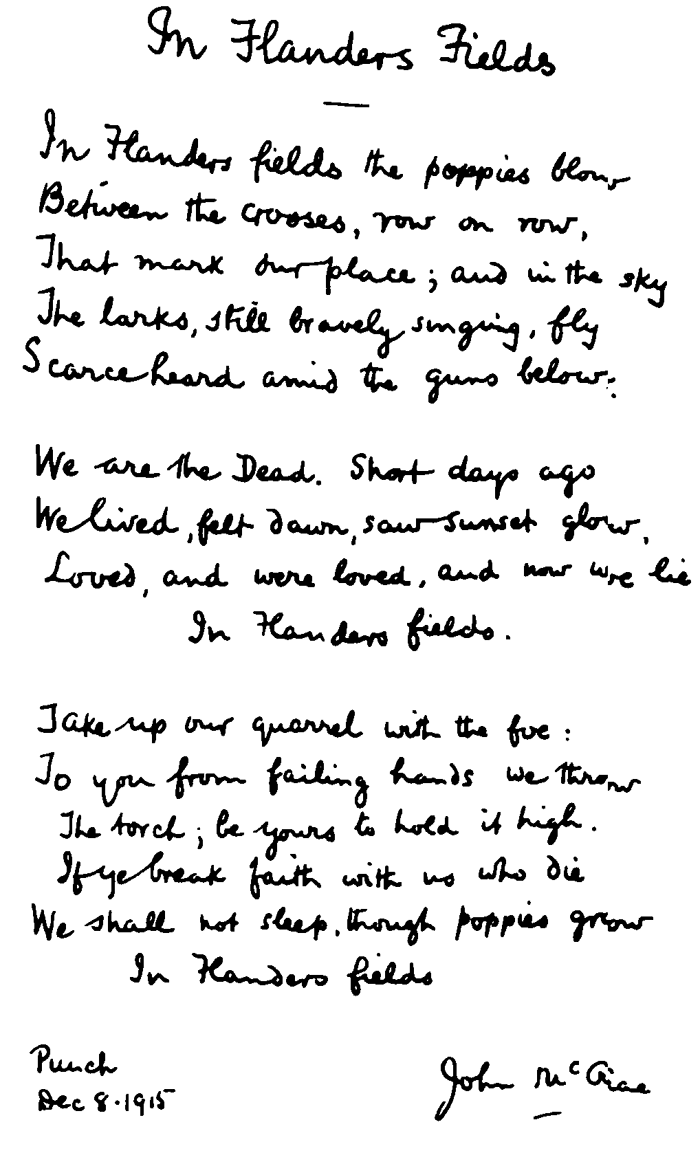
In Flanders fields the poppies blow
Between the crosses, row on row,
That mark our place; and in the sky
The larks, still bravely singing, fly
Scarce heard amid the guns below.
We are the Dead. Short days ago
We lived, felt dawn, saw sunset glow,
Loved and were loved, and now we lie
In Flanders fields.
Take up our quarrel with the foe:
To you from failing hands we throw
The torch; be yours to hold it high.
If ye break faith with us who die
We shall not sleep, though poppies grow
In Flanders fields.
 A minutes silence, and flag at half-mast at Echuca, Vic, 2006. J.
 The interior of the Royal Exhibition Building, Melbourne. Used for just about everything, since 1880, in 1918 this was an emergency flu hospital. J.
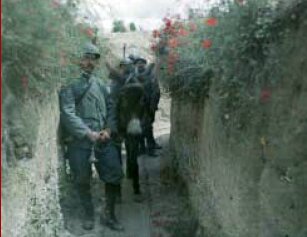 French trench with a donkey and poppies. This is the only colour photograph (one of two processes used at the time) known to show poppies on the battlefield, and was taken in 1915 by an official French war photographer.
  James
James


 Posts
All Comments
Posts
All Comments