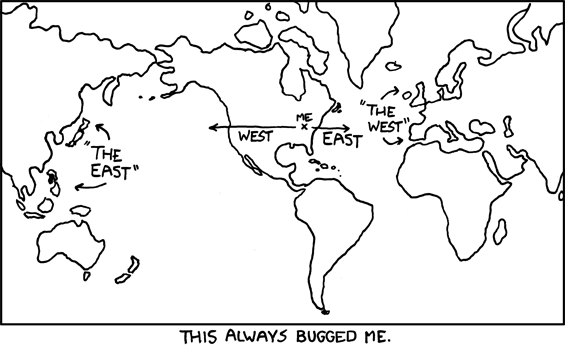
(And for those in the northern hemisphere, please also learn 'north' does not = 'up'.)
James


 We've returned from a pretty intense trip through New Zealand and North America, and only now are we getting to stuff like the blogs. Watch this space though, there's lots to come.
"In honor of Beach Blanket Babylon's 35th Anniversary, the San Francisco Airport is presenting a display of various hats that have appeared in the show throughout the years. At San Francisco International you will find the 25th Anniversary Skyline Hat, which was first presented at the Herbst Theatre in 1999. This lavish hat, which was part of our Silver Anniversary finale, paid tribute to Steve Silver. The hat is 15 feet wide, 10 feet deep and grew to 29 feet tall. At 300 pounds, the brim alone required 60 yards of taffeta and 200 ostrich feathers."From Jo Silver's blog here.
 Lake Okanagan, -25 degrees C (-13 F).
 Maryborough, Victoria, Australia. 25 degrees C (77 F) at night.
 Montecito, California.

For his first six years, Carle lived in upstate New York with his parents, who had emigrated from Germany. In the mid-30s his mother, homesick, took the family back to Stuttgart at a time when everyone was trying to move the other way. War broke out, his father was drafted into the German army and spent eight years as a prisoner of the Russians. Before the war, he had been his son's great ally, a gentle man, an amateur artist. When he came back, he was broken. Carle turns over the memories of this period slowly. He is very careful to get things right.And art, as so often was important - perverted for power or (as the Nazis had it) 'degenerate':
His mother was supportive of her son's love of art - "in awe" of it, in fact - but was in other ways a rather distant figure. She was not a "warm" individual. "She was a good mother. But ... I hate to say this... I loved her, she was responsible, she was good ... But I don't have this feeling which I have towards my father, as something incredibly deep. When I was little, from the beginning, he read the funny papers to me, told me stories, drew pictures, went for walks. Telling stories and walking and stopping and looking; nothing terribly important. But that has been so important in my life. The older I get, the more I know that's so true."
Carle was 10 when his father left for the army and 18 when he came back, "this sick man. Psychologically, physically devastated." Did he try to coax him back to his old self? "We didn't talk any more much. Only superficial things. I had other interests. I was in art school, an artist. I was interested in women." He puffs out his chest in parody of his 18-year-old self. "This old man, coming from Russia, we got along without you." That's pretty much how it felt, he says. "It's so sad."
The other seminal figure in his childhood was Herr Kraus, his high school art teacher, who at great personal risk noticed Carle's talent and invited him to his house to look at banned art; in Carle's memory, it was Klee, Matisse and Picasso, but he can't be sure. Anyway, it was expressionist and it made a profound impression on him. "I didn't have the slightest idea that something like that existed, because I was used to art being flag-waving, gun-toting Aryans - super-realistic Aryan farmers, the women with their brute arms. That was art. Of course. That was a shock."
 Eric Carle. Photograph: Maggie Steber, via The Guardian.
The Very Hungry Caterpillar was initially conceived of by Carle as a hungry bookworm, eating its way through the pages. His long-time editor, Ann Beneduce, wasn't sure about a worm as a central character and suggested a caterpillar. "Butterfly!" exclaimed Carle, and so it was born.It's easy to project meanings into these books. As vehicles for acorn imaginations, they can be a lot of things. Adults, as ever, can be pretty crude.
"I often joke," he says, "that with a novel you start out with a 35-word idea and you build out to 35,000 words. With a children's book you have a 35,000-word idea and you reduce it to 35. That's an exaggeration, but that's what's taking place with picture books."
The book's success has spawned a lot of crank interpretations. It has been described as an allegory of both Christianity and capitalism. "Right after the Wall fell, I was signing books in the former East Germany and was invited by a group of young librarians to have lunch with them. One said the caterpillar is capitalist, he eats into every food one little bit and then the food rots away. Wasteful capitalist. Interesting. I think that if you're indoctrinated, that's how you will see it."As a kid myself, I was never a fan of The Very Hungry Caterpillar; my graphic requirements from books were always more stringent than the rough-edged collage of Carle. I may not have been a fan, but I can certainly respect the achievement. It remains a justified best-seller.
The success of my books, I think is also due to their emotional impact. Caterpillar, for instance, is a book of hope. It says that you too - an ugly, little thing - will open your wings and fly. Kids who are insecure and young identify with that."Insecurity? They know that the future is unwritten, and who knows what current activities will help them in the future. Perhaps they are just more realistic about life's potential.


 Posts
All Comments
Posts
All Comments


