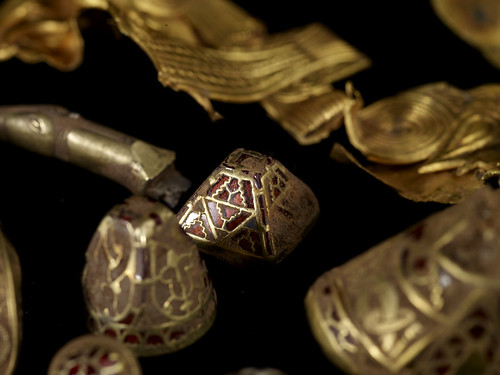
 Images from the Staffordshire Hoard Flickr pages.
Very occasionally something tremendous comes along. Something that makes us re-evaluate our collective past by providing a huge new selection of jigsaw pieces for the great puzzle that is history.
On September 24th an announcement was made: a huge hoard of previously-unknown artifacts from the Anglo-Saxon era had been discovered in Staffordshire. The discovery, in June, of gold and precious objects was in the process of being catalogued and conserved and would soon go on display. (Even a museum can act quickly when enough gold and publicity are running around.)
What is it about a hoard? The word itself - hoard - conjures up its friends 'loot', cousin 'booty' and great-aunty 'treasure'. Pot of gold at the end of the rainbow: crock of coins buried for safer days, lost to history. Discovery by the worthy, as in the fairytale younger son (or daughter).
We learned about this era at school (when we weren't reading fairytales about pots of gold). It was called 'the dark ages', not (as we thought) because they all wore tights and lived with their livestock in dark low houses, but because there are so few artifacts. So little evidence. More critically, later eras were documented in a way that made it 'history' to us: names and dates, battles and treaties, inventories and so forth.
Finds like this enable both archaeologists and historians to answer some existing questions -- but also to propose some new ones. Long-held perceptions of the time and its people will, no doubt, be overturned and restructured. It's almost as exciting as, well - a pot of gold.
The size of the find is enough alone to out 'gee-whizz' most sceptics. It contains, '... in excess of 1,500 objects made from various metals' including '5kg of gold and 1.3kg of silver'. By contrast, the Sutton Hoo find, generally accepted as the largest or most significant find of the type contained a mere 1.66kg of precious metals in total.
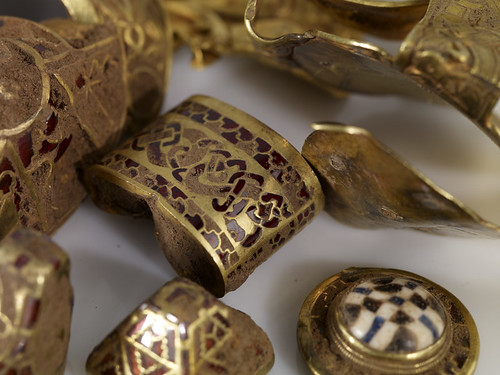 The bracelet in the centre of this photo echoes motifs familiar from the Sutton Hoo treasures, but of course adds to our understanding of the making and spread of such items in Anglo-Saxon England. But, just like Sutton Hoo, we don't know whose treasure it was.
 The Sutton Hoo discovery had enormous value in other ways. A hoard within a ship burial, it contained a significant and (essentially) complete array of objects belonging to one individual at the time of their death. Or at least, so we think.
The Staffordshire Hoard, on the other hand, offers apparently no contextual information, at least not yet. It is just the precious items - probably from one exalted person, or court, but even this may be impossible to define with any degree of certainty. It is the difference between trying to find out about someone's history and story by having either the remains of their sitting room and car -- or just the things in their safety-deposit box (without any paperwork).
.jpg) A damaged gold plaque showing two birds of prey gripping a fish was part Britain's largest haul of Anglo-Saxon treasure, which was discovered buried in a Staffordshire field. (Eddie Keogh/Reuters, via CBC report)
A damaged gold plaque showing two birds of prey gripping a fish was part Britain's largest haul of Anglo-Saxon treasure, which was discovered buried in a Staffordshire field. (Eddie Keogh/Reuters, via CBC report)When she sent us the link, we were talking about the find on email and Tamsin said: "I love the gold plaque of the birds of prey grasping a fish, fabulous scrollwork..."
Given that all of this material was hand worked by individuals without any of the mass production or power (or even magnification) tools that we take for granted in our industrial age, the hoard is even more impressive. And consider that the value of the items in the hoard -- as compared to the material available to the average person of the era -- it's in a relative sense as outstanding as any King's ransom, crown jewels or even the whole British Museum itself.
The hoard has sparked enormous interest from archaeologists, historians, press and public. Dr Kevin Leahy, from the Portable Antiquities Scheme, said of the Anglo-Saxon treasure:
"The quantity of gold is amazing but, more importantly, the craftsmanship is consummate. This was the very best the Anglo-Saxon metalworkers could do, and they were very good. Tiny garnets were cut to shape and set in a mass of cells to give a rich, glowing effect; it is stunning. Its origins are clearly the very highest-levels of Saxon aristocracy or royalty. It belonged to the elite."
Leslie Webster, Former Keeper of the Department of Prehistory and Europe, British Museum, has already made it clear that:
"This is going to alter our perceptions of Anglo-Saxon England… as radically, if not more so, as the Sutton Hoo discoveries. Absolutely the equivalent of finding a new Lindisfarne Gospels or Book of Kells."More information can be found at the Staffordshire Hoard website, and photos on the hoard's Flickr pages.
James & Bev





 Posts
Posts

