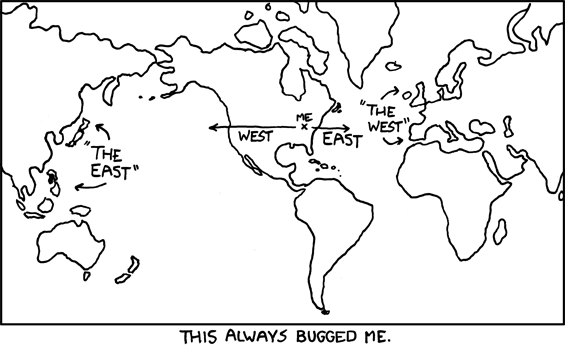
(And for those in the northern hemisphere, please also learn 'north' does not = 'up'.)
James
 I don't think this café was always a café, you know. And how 'HB' can be the initial letters for 'Clothing Factory' beats me.
 Mermaid in the Museum of Wellington City & Sea
 Keep right in the cablecar.
 Blue skies and the observatory
 Maori carvings awaiting erection
 I think the market will crash soon.
 ...
... Pretentious architecture and blue lights.
 Cause sunbathing later
 Restaurant & fishing boat
 Hooked on Scotland.
 The light in the old cathedral.
 And the words on the University Bookshop.
 amam Wag.
 Wake.
Wake. Beached boat.
 Beached whale?
 Protected stream.
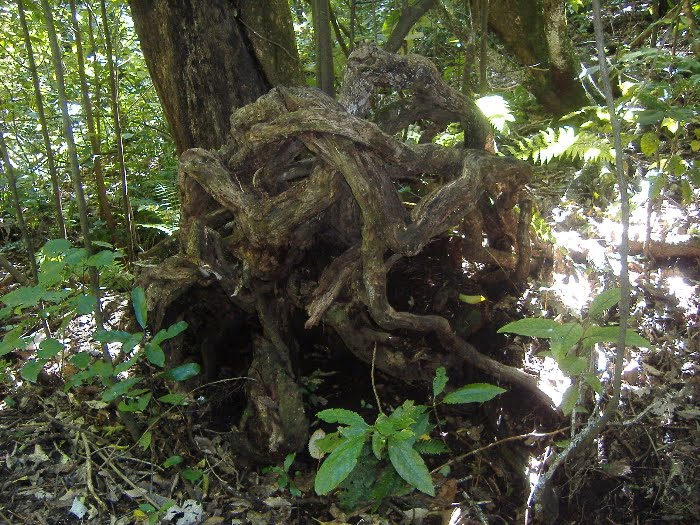 Gordian knot.
 A water gate and window box achieving an Italian flag effect.
 Candleholder for your plaque. Otherwise who is going to be scared by your wolf by night?
 The vital Venetian chimney tops to collect sparks and avoid fire. Despite all the water, fire was a major risk.
 Don't feed the cherub too much spinach.
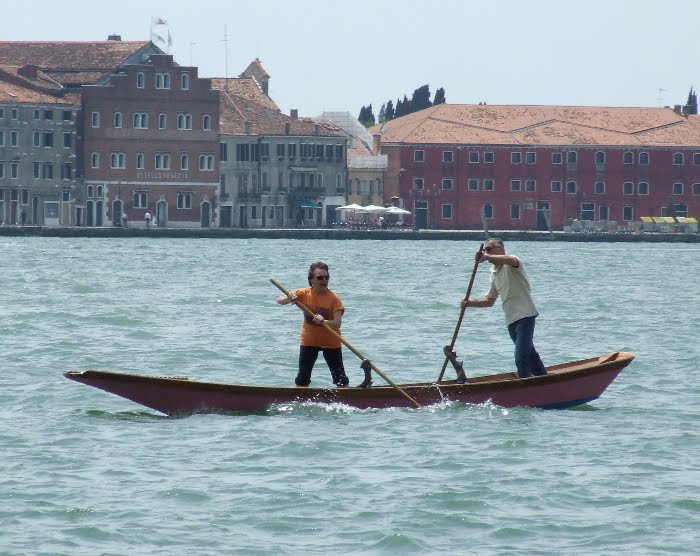 "When you said two outboard motors, I thought..."
 A delivery barge, a tree, a nap and thou...
 The original Arsenal. Interestingly this Naval shipyard is still closed to the public, but I suspect the defences of Italy aren't dependant on their products as Venice's were.
 Garden and church.
 You can't get the plasterers to finish a job properly, here.
 Church with tollbooth. Or is is an aquatic confessional?
 Bombed on the beaches, British soldiers use Lee Enfield rifles to fire back at the German Luftwaffe. (BBC.)
 Here in the Imperial War Museum, London, is one of the little ships of Dunkirk- in fact the littlest, Tamzine - sailed by amateur or professional civilian sailors that brought the soldiers off the beaches. Author.
 The flag is also seen a lot on cars around Australia day, but not often as large and frequent as on this ex-US Naval Jeep. Perhaps he wanted the nationality of the owner to be unmistakable?
 One of the great things about Australia is how many things actually are a mess, and don't make a lot of sense. This includes our flag, which isn't even all ours. The Australian flag can be easily confused for the New Zealand one, both being a quarter borrowed from Great Britain's Union Flag, and with stars on. (The Kiwi's one has fewer stars, and their stars are red.) To confuse matters further I thought I'd do a quick survey of some of Australia's flags. So here's a selection.
 Seen here being dropped (with accessories) in front of Melbourne to open the Royal Australian Air Force (RAAF) Museum's Pageant, this is the RAAF Ensign. The bit with the kangaroo in the roundel is folded over, of course.
 The Royal Australian Navy Ensign has a white ground with blue stars, and is similar in colours to the Royal Naval ensign.
 Seen by another lighthouse, Cape Ottway, this photograph by Pam shows the Australian flag again, but partnered with the Aboriginal flag.
 "The designer of the flag, Harold Thomas, who owns the copyright to the flag, refused to give Google permission to reproduce the design on its website, Google said." The Age went on to state: "Thomas, who lives in Humpty Doo in the Northern Territory, said he refused only because Google did not approach him in a respectful way and had demanded to reproduce the flag without charge."How very Australian. And very Australian too is flags at the cricket, as seen here at the MCG.
 So you were wondering what it is made up of, right? The Australian flag is composed of three parts: The Union Flag (often known by its nickname the Union Jack) in the top left corner, the 'Star of Federation' in the bottom left corner, and The Southern Cross, taking up the right half of the flag. The Star of Federation is a seven pointed star, representing each of six states with a point on the star, and one more point for Australia's territories. The Southern Cross is a constellation that can be seen from all of Australia's states and territories, of course. The Union flag ensures that Australia carries (combined) the full set of the flags of the countries that make up Great Britain, while failing to do the same for its own states and territories. Very Australian.
 As Australia is a federated country, each state does have its own flag. This is the Victorian example, with its own Southern Cross.
 Sorry. So to finish, I'd like to introduce another nation's flag. The 26th of January is shared with India as they celebrate their Republic Day, and despite the recent sad events, most Indians share a great time and their marvelous culture with us in Australia. This final picture was taken on Australia day a couple of years ago as the Indian contingent in the parade passed by.
 James
James
 Today is Australia Day. It's the 222nd anniversary of the First Fleet arriving in what was to become Australia on 26 January 1788, starting the European settlement of Australia that has continued to this day. The Sydney Museum has an excellent model of the First Fleet ships on show (below) and I wonder how many of those aboard realised they were arriving in mid-summer?
 Of course the First Fleet was a direct result of the arrival of Lieutenant James Cook in His Majesty's Barque Endeavour on one of the world's great voyages of exploration. (The introductory image at the top shows the replica of HMB Endeavour sailing up the Yarra in Melbourne.) Again, an aspect of Cook's exploration of the Eastern coast of Australia and the arrival of the First Fleet is that it could so easily have been a French story, as the French Navy were literally on the spot - or in the natural harbours - at both events. While there are a scattering of French names (particularly in Tasmania - itself based on a Dutch navigator's name) it's a monolingual Anglophone culture in law. Yet it could have been like Canada, with a foot in both French and British culture and language, or a member of the Francophone world like -er- Monaco.
 Often overlooked near the Circular Quay in Sydney is this mosaic map (above) showing the very first developments of what was much later to become the city of Sydney, Australia's eternal second best conurbation.
 Of course, the First Fleet was the beginning of a social experiment that failed at its origin - to export 'the criminal class' from Britain, and to develop colonies with these prisoners. No one has yet managed to export their 'criminal class', so that part was a failure, but we seem to have managed to build quite a habitable country on this unprepossessing foundation. The convicts would try to escape from the marines and soldiers (obviously to get to what would become Victoria and Melbourne from the rather inferior Sydney and New South Wales) as seen above at Sovereign Hill historical re-enactment. But to get away they would have to get through the Blue Mountains (below) one of Australia's natural wonders which is essentially untouched except for the viewing platforms and coach parking (not included in the picture).
 And when it's been another great Australia Day here, and we are rolling home with a beaut sunset to the West, it's the start of another cold, winter's day in Britain. We've just celebrated five years and one day here, and it's bonzer, mate.
 James (a Melburnian)


 Posts
All Comments
Posts
All Comments


