Showing posts with label England. Show all posts

Wednesday, July 10, 2013

Let's start with one Pom down - Again


The Ashes are back, some light (currently Nottinghamshire) sunshine in a particularly cold Melbourne winter, and the inimitable Blowers & co of TMS on the radio.  But that's all that's the same as 2009.

We've got one Pommie wicket (Cooked the Cookie... a valuable one, but all the early wickets are) but it has to be said that all the smart money's on England, and the team, which is strong, is unusually surrounded by a resurgent British sporting context with well deserved victories an a remarkable array of international sports, a state of affairs I can't remember having a precedent in decades.  It may have started with London (and Britain's) magnificent hosting of the most recent Olympics, something the UK should really take great credit for.

First drinks, but we don't get the Shipping Forecast. No "... Malin, Hebredies..."

In 2009 I asked ' The tough question is, as ever, whether I can find someone to venture five quid on England.' Delighted to get a $10 onto Australia with our best new Australian from Essex, Sally.  I reckon she's got a good chance at my cash, but as well as Australian victory, I'd mostly like a close, great series.

There's a new round of missing faces, and the picture below is now definitely regarded as 'history' by the commentators.


It's nice to realise you can remember some of the best cricket in its history. Will this be another great series?  The great thing about the ashes is you never really know.

So let's hop back to 2009.  "We have five Tests of five days in Wales and England to look forward to. And in the fine tradition of the game, anything might happen, and much of it probably will. It is certain that it will, however, finish in my old home ground of Surrey's Oval. Among other games I recall seeing Australia give away the last Test to England after a victorious series, and being there as Black Sarf London demonstrated the stupidity of Tebbet's Cricket Test as they celebrated the Windies' Blackwash - one of the nosiest and most intense days I can remember, including fast-jet time...

The Windies in their pomp were something to see, a machine which still echoes to today, but impressive as Big Bird was, there's nothing like the Ashes, right down to one of the most quixotic trophies - that actually isn't."

Remember, there's other sport stuff, and then there's The Ashes.

James

This post might not make sense if you don't speak cricket. A more comprehensible intro here from the BBC.

Wednesday, May 1, 2013

Space! The flight's delayed...

I really like the latest* cover of the New Yorker.


I like the slightly retro look and feel, but what makes it special is the juxtaposition of the spaceport outside (Kids!  It's the future!) and the all-too-familiar airport lounge (Kids!  Stop running around!**) the two separated by the humongous architect's windows.

They can make big windows in the airport, but the 'planes are still late.  What do you think space travel will become like?  Mundane, just like air travel did.

The facts are the image is Luke Pearson's 'Now Boarding', details and background on the New Yorker's website here.

James

*Latest here - that's two issues ago to New Yorkers.

**To be fair, while the kids are running in the pic, there's no conflict pictured in the lounge.  I just projected that.

Wednesday, November 7, 2012

You're *not* the centre of the universe

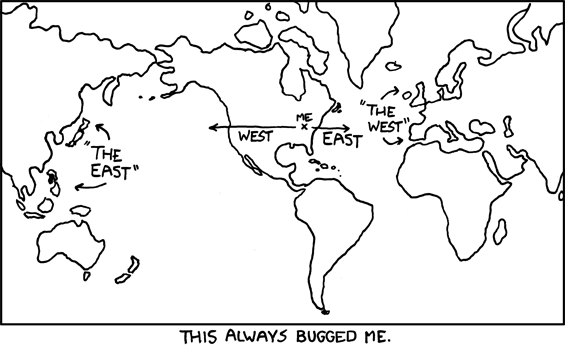
From the great xkcd, puzzled that an older civilisation would have got naming rights for much of the world, and understandably puzzled by using relative locations.

(And for those in the northern hemisphere, please also learn 'north' does not = 'up'.)

James

Friday, November 25, 2011

Gated


Olli has an access problem at the White Horse, Uffington, 1st July 2008. Photo by Bev.

Thursday, August 25, 2011

Perfect Headline

Sometimes the headline is just sweet:

Woman uses stiletto to attack ATM

What's not to love? As you'd expect that's basically the best bit, although "The machine ... was struck 'almost 50 times' by a woman shortly after midnight on 2 July." is a pretty good sentence. Sometimes spending your carefully hoarded kebab money on that extra cocktail in the knowledge you can ~hem~ 'hit' the ATM is a mistake, particularly when the &^%$%# machine refuses to hand over the cash.

The article finished by saying that the Police would like a chat. I'd hope it would be for tips on grip and angle, and what kind of stiletto does the best damage.

James

For those who want the rest of the story, it's here, with video. I like how she hammers the thing, puts her shoe back on, goes 'beep boep boop beep' "No Cash" and then calmly has another attitude adjustment on the machine.

Wednesday, December 29, 2010

England Retain the Ashes

The MCG at lunch, day three, with the kids on the field.

Well, yesterday was a painful day. After the 'series of a lifetime' England win in 2005, where both teams delivered the most exciting sport you can imagine, followed by a five-nil whitewash of the tourists when England came to Australia in 2007, and an average series, rightfully won by England in 2009, the improvement in England's cricket and the remarkable collapse of Australia's team was made stark, with Australia's one win of the series (with one to play) being liked by a commentator to a 'dead cat bounce'. As that win was essentially down to a remarkable one-off bowling performance by Mitchell Johnson, ironically backed up by a high score with the bat as well, it rather obscured the rest of the team's poor performance.

Excepting house-hero Hussey, Australia's batsmen have consistently failed, and again it was ironic that Victorian Siddle managed a test-high score with the bat in a sinking cause this morning, scoring 40 with Brad Haddin to stave off certain defeat for an hour more.

The post-mortems have started, and there will be a major reconstruction of the Australian team in the near future. One simple fact stands out to me (and not widely remarked elsewhere) is that Australia needs more than one bowler to be able to take a swag of wickets a game, and when that same man is significant among your high scorers, then the others need to do more than just turn up.

Australia's captain Ponting has not been a favourite here, and his disgraceful argument with the umpires and England batsman on day two is symptomatic of his buckling under pressure, again. Another point not widely made is that he is now neither in batting form nor fit to act as a behavioural example for the current Australia team, or that which must be under rebuild very soon. Inheriting Waugh's world beating team and tough attitude, after the retirement of a suite of greats, Ricky has shown he can neither perform with the bat nor develop a new team from a cauldron of opponent's pressure in the way that Alan Border did, and set that 70s Australia team on the road to greatness.

England's performance was almost flawless - but more importantly showed batting in depth, and not only did their first 'set' of bowlers deliver, the three brought in after changes were as effective as their predecessors. Fielding and morale stayed high, and England looked a strong team, rarely being knocked, even at the WACA loss.

Sadly supporters on both sides resorted to boos at disfavoured players at times, and on the third day the booing of Ricky Ponting as he walked out was thankfully surpassed by a more appropriate clapping and cheers. Generally the crowds were well behaved, and England's Barmy Army provide entertainment to everyone except the most one-eyed Aussie supporter. Billy Cooper's trumpet is now an enjoyable game fixture. Both of us were frankly surprised by the number of England supporters, which, given the distance and cost (some questions over monopolistic practices for the tickets they were able to buy didn't sound very hospitable when we heard about them) shows a dedication to their team that's laudable. As one England supporter in front of us responded to a boorish Aussie behind us, they've had to put up with Australia for twenty years, and I agree the England fans and team have every right to make hay and celebrate - they earned it.

It's called 'test' cricket as it is a pressure game, testing as it gets, and class, and performance will overcome temporary form and however much luck you can get. After the 25 possible days play is up, the best team stands clear. Both statistically and in evident attitude, the gulf between the teams is huge - no great comfort to an Australia supporter that it looks like a reversal of the team's roles around the 2000 period.


We took our two English guests to the G yesterday, and for their first day of real test cricket they couldn't have had a much better one - painful though it was for us! That was a pleasure - as well as the fact that some of the young lads playing at lunch (top) will perhaps be in a future Australian slide the equal of the Invincibles and Waugh's men. Oh, and that Australia still has the greater number of Ashes wins, series wins, retentions, period of ownership, and, of course, the first series win which started it all.

But we must finish with due credit to a perfect team performance by Strauss' England squad. The best team won.

James

Sunday, December 26, 2010

Well that was England's day

Words fail me, so over to Peter English, summarising Australia's batting on Cricinfo:
"...the side face-planted on the biggest occasion of the cricket calendar."

Tuesday, December 21, 2010

One - One and Two to Play

And this* may be the only space left at the G on Boxing Day if predictions turn out. A history in pictures here, and a summary of the history and atmosphere here.

James

*Taken in December 2008 at the South Africa Test.

Saturday, December 18, 2010

Waugh on Cricket

Sadly we aren't allowed TMS here in Australia, ABC's Grandstand having exclusive rights - ironic, as several of the commentators swap seats from one box to the other. (Still, TMS are welcome to keep Boycott.) Cricket wouldn't be worth it without the radio.

At home, a couple of days ago we had a Canadian visitor who was somewhat puzzled by the method of following the game as well as being puzzled (of course) by the game itself. Like the unique nature of the twenty-five day test of quality, having a TV on and mute while listening to the radio is probably not seen in many other sports.

If you want a man to bat for your life...

TMS's Aggers, guesting on Grandstand mentioned he'd interviewed Steve Waugh over on 'the other channel' and after a bit of online searching, this is one we can listen to. As ever, two top cricket analysts make a great interview. Lots of ground covered, and it's here.

Meanwhile today retired Australia opener Matthew Hayden stopped by the ABC commentary box and impressed us, sandwiched between two more regular commentators. I doubt you'd get the average soccer player discussing his chickens, best farm manure, and how to produce a fruit reduction for your Christmas ham and offering the recipe over the airwaves in between the more normal sporting recollections. However remembering listening to the cricket with ABC while a kid on the back of his dad's tractor is just as expected.

Oh, the test match? What a day's cricket! What it's all about. As Vic Marks of The Guardian said:

This has been a proper Test match, the best of the series by far. There were times during the first two matches when it was possible to wander off around the back of the stands for a pie (in Brisbane) or a Pimms (in Adelaide) in the knowledge that nothing of great significance would be missed. In Perth it has been foolhardy to take the eyes away from the action for a minute.

He added:

Mike Hussey, yet again, was the rock for Australia. He hit his second century of the series in front of an adoring crowd on his own turf. He now has 517 runs in the series at an average of 103 and here England probably only dismissed him because he was stranded with the last man again.

If England win from here, the remaining batsmen will deserve soup-plate gold medals, not just OBEs. That said, it looks like we'll be going to the G on the Boxing Day Test with a live, and exciting series. What more could you ask for for Christmas?

James

Friday, December 17, 2010

Single left-hander...


Hussey is probably the only Australian player who has done his job in the three tests. ABC.

I hadn't written about the Ashes tests since the last post, because in the words of a great Australian captain, "There are two teams out there, one is playing cricket. The other is making no attempt to do so."

Sadly the issue was that Australia's team were simply not up to the level of Ashes test cricket.

Conversely, England's players were clearly a team, all credit to them - they have played well as a team, and looked solid, not missing chances, rebuilding after knocks and being top class batting, bowling and fielding. Good cricket depends on both teams finding form, and playing well, together, and Australia were certainly - to be as kind as possible - out of form. They were a sad shadow of the team of Waugh's era. The fielding was poor, and the batting from the dedicated batsmen for the most part a disgrace. But after a couple of sparky individual performances up to yesterday - including another solid batting performance by Hussey and Haddin, and a remarkable high score with the bat by fast bowler Mitchell Johnson, today saw the contest really come to life with two teams fighting on form. Tellingly it was a dedicated fast bowler that high-scored for Australia yesterday, and it's ironic that the same chap was responsible for knocking over most of England's team today in one of the tightest, most effective single bowler efforts I've seen. When you're hot...

Mitchell Johnson (and that tattoo) celebrate another England wicket.

As another great Australian bowler,
Terry Alderman, now summarising for the ABC's Grandstand commentary said: "Single-handedly Mitchell Johnson has got Australia back in the game." I'll just mention Mitch is a left-hander.

An 18 minutes ABC highlights summary here.

Obviously I'm glad Australia's back in the game, and serious, but better still for everyone is that as I write tonight, this game (and the series) is now really in the balance, and we've seen (and hopefully will see) some really good cricket by both sides, which is what it should be about. Serious questions remain. Ponting's poor scores with the bat mean (were he not captain) he'd almost certainly be out, but Clarke, the deputy, is fairing little better and no obvious other successor. A sad reflection on the previous solid succession planning Australia developed through the 1990s and early 21st century. Another pressing question is what was Johnson thinking with that tattoo. No, really, no.

Strauss' men can, on their performance to date, be proud of being one of the best England teams to tour Australia for a long time; let's hope they keep it up. But let's also hope that
Australia do so as well, and give us a series to rival the 2005 Ashes.

Here's to a good contest!

Tuesday, January 26, 2010

Australia Day 1: 1788 and all that

Today is Australia Day. It's the 222nd anniversary of the First Fleet arriving in what was to become Australia on 26 January 1788, starting the European settlement of Australia that has continued to this day. The Sydney Museum has an excellent model of the First Fleet ships on show (below) and I wonder how many of those aboard realised they were arriving in mid-summer?

Understandably, there is a view that the Aboriginal peoples who were already living here may have a rather less positive perception of the arrival of these convicts, sailors and marines. Although it has no effect on the tragic history of Aboriginal rights and life since that day, it's often forgotten that Australia really is entirely a land of immigrants as all the humans arrived from overseas - the earliest remains found in Australia are Mungo Man from 40,000 years ago. Estimates often giving a remarkably recent figure (in pre-history terms) of between 40,000 to 50,000 years for the first colonisation of the continent, although some believe it to be much earlier.

Of course the First Fleet was a direct result of the arrival of Lieutenant James Cook in His Majesty's Barque Endeavour on one of the world's great voyages of exploration. (The introductory image at the top shows the replica of HMB Endeavour sailing up the Yarra in Melbourne.) Again, an aspect of Cook's exploration of the Eastern coast of Australia and the arrival of the First Fleet is that it could so easily have been a French story, as the French Navy were literally on the spot - or in the natural harbours - at both events. While there are a scattering of French names (particularly in Tasmania - itself based on a Dutch navigator's name) it's a monolingual Anglophone culture in law. Yet it could have been like Canada, with a foot in both French and British culture and language, or a member of the Francophone world like -er- Monaco.

Often overlooked near the Circular Quay in Sydney is this mosaic map (above) showing the very first developments of what was much later to become the city of Sydney, Australia's eternal second best conurbation.

Of course, the First Fleet was the beginning of a social experiment that failed at its origin - to export 'the criminal class' from Britain, and to develop colonies with these prisoners. No one has yet managed to export their 'criminal class', so that part was a failure, but we seem to have managed to build quite a habitable country on this unprepossessing foundation. The convicts would try to escape from the marines and soldiers (obviously to get to what would become Victoria and Melbourne from the rather inferior Sydney and New South Wales) as seen above at Sovereign Hill historical re-enactment. But to get away they would have to get through the Blue Mountains (below) one of Australia's natural wonders which is essentially untouched except for the viewing platforms and coach parking (not included in the picture).
And when it's been another great Australia Day here, and we are rolling home with a beaut sunset to the West, it's the start of another cold, winter's day in Britain. We've just celebrated five years and one day here, and it's bonzer, mate.

James (a Melburnian)

Saturday, January 2, 2010

When 'boats flew with elegance & style

All I wanted for Christmas was a new two-hundred mile an hour two-deck Imperial Flying Boat!


Two posters from the Smithsonian: 'Fly Now: The National Air and Space Museum Poster Collection'. This one is an interesting variation on the period's aviation posters with a forced perspective to imitate the unbelievably high bow of the luxury transatlantic liners of the day, most famous with the Normandie poster.

The Smithsonian's blog about this collection is here, and the posters are here.


The right crowd and no crowding. Glad to see the little girl has to stand on tiptoe to see the elephants stampeding below. As you'd expect, while the physical shapes of some of the passengers are biologically impossible, the decor is absolutely accurate.

James
___________________________________________
Top:
Sponsor: Imperial Airways
Artist: Severin
Inventory Number: A19901003000
Country of Origin: United Kingdom
Dimensions: Unframed: 100.97 x 63.5cm (3ft 3 3/4in. x 2ft 1in.)
Materials: Offset Lithograph
Physical Description: IMPERIAL AIRWAYS Multicolor commercial aviation print. Seaplane (Short S.23 Empire Flying Boat, G-ADHL) in harbor with what appears to be tugboats on either side of it. Rear view of seaplane. Multicolor, but mostly blue and white image on paper. Partial text: "Imperial Airways Europe Africa India Far East Australia"


Lower:
Sponsor: Imperial Airways
Manufacturer: Haycock Press
Artist: Chandler
Date: 1936
Country of Origin: United Kingdom
Dimensions: Unframed: 49.53 x 31.75cm (1ft 7 1/2in. x 1ft 1/2in.)
Materials: Offset Photolithograph/Letterpress
Physical Description: Interior scene of Short Empire flying-boat (Short S.23); well-dressed passengers read, drink wine, look out window at a coastal scene, text block at bottom; multicolor image on paper. Full text: Luxury in the new Emprie Flying Boats Imperial Airways Europe, Africa, India, China, Australia


Wednesday, November 18, 2009

British Steampunk is alive and recordbreaking...

From the British Steam Car website.

Another land speed record falls to the UK. Perhaps one that's not exactly facing ferocious competition these days, but it is the fastest steam-powered car in the world.

On August 25th, 2009 at Edward's Air Force Base in California, USA, the British Steam Car, driven by Charles Burnett III broke the existing land speed record by a steam powered vehicle with an average speed of 139.843 mph over two consecutive runs over a measured mile. This was recorded and has since been ratified by the FIA.

On August 26th, 2009 the British Steam Car, driven this time by Don Wales, broke a second record by achieving an average speed of 148.308 mph over two consecutive runs over a measured kilometer. This was also recorded and again, has since been ratified by the FIA.

From the Steam Car website.

BBC Report here.

Well done, team, and that'll teach them to say steam power is dead! Not to mention the recent construction of an all new mainline steam engine in the UK. (That would be the 170 tonne 18 year project locomotive No. 60163 Tornado.)

Oh, and for those that might be puzzled by the headline, Steampunk (Wiki page) refers to an aesthetic and idea combining generally 19th century concepts (such as steam power) and style with more modern developments, usually along an alternative history line - William Gibson & Bruce Sterling's The Difference Engine being often cited as a pioneer of the idea - and a rattling good yarn too. But they didn't foresee this real-world steam development.

(Thanks to Ross for the pointer.)

James

Sunday, November 15, 2009

A Golden Hoard

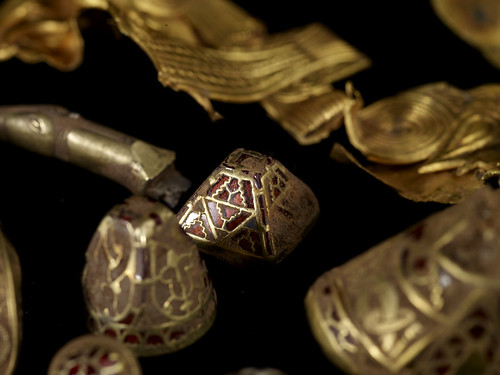
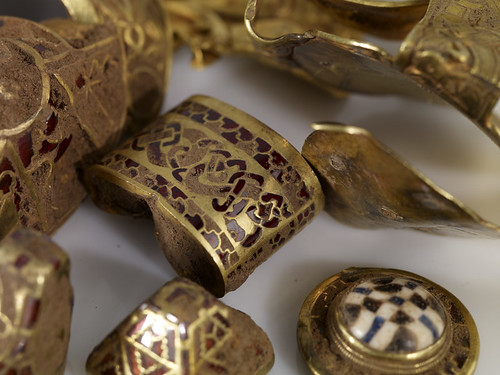
Images from the Staffordshire Hoard Flickr pages.

Very occasionally something tremendous comes along. Something that makes us re-evaluate our collective past by providing a huge new selection of jigsaw pieces for the great puzzle that is history.

On September 24th an announcement was made: a huge hoard of previously-unknown artifacts from the Anglo-Saxon era had been discovered in Staffordshire. The discovery, in June, of gold and precious objects was in the process of being catalogued and conserved and would soon go on display. (Even a museum can act quickly when enough gold and publicity are running around.)

What is it about a hoard? The word itself - hoard - conjures up its friends 'loot', cousin 'booty' and great-aunty 'treasure'. Pot of gold at the end of the rainbow: crock of coins buried for safer days, lost to history. Discovery by the worthy, as in the fairytale younger son (or daughter).

We learned about this era at school (when we weren't reading fairytales about pots of gold). It was called 'the dark ages', not (as we thought) because they all wore tights and lived with their livestock in dark low houses, but because there are so few artifacts. So little evidence. More critically, later eras were documented in a way that made it 'history' to us: names and dates, battles and treaties, inventories and so forth.

Finds like this enable both archaeologists and historians to answer some existing questions -- but also to propose some new ones. Long-held perceptions of the time and its people will, no doubt, be overturned and restructured. It's almost as exciting as, well - a pot of gold.

The size of the find is enough alone to out 'gee-whizz' most sceptics. It contains, '... in excess of 1,500 objects made from various metals' including '5kg of gold and 1.3kg of silver'. By contrast, the Sutton Hoo find, generally accepted as the largest or most significant find of the type contained a mere 1.66kg of precious metals in total.

The bracelet in the centre of this photo echoes motifs familiar from the Sutton Hoo treasures, but of course adds to our understanding of the making and spread of such items in Anglo-Saxon England. But, just like Sutton Hoo, we don't know whose treasure it was.

The Sutton Hoo discovery had enormous value in other ways. A hoard within a ship burial, it contained a significant and (essentially) complete array of objects belonging to one individual at the time of their death. Or at least, so we think.

The Staffordshire Hoard, on the other hand, offers apparently no contextual information, at least not yet. It is just the precious items - probably from one exalted person, or court, but even this may be impossible to define with any degree of certainty. It is the difference between trying to find out about someone's history and story by having either the remains of their sitting room and car -- or just the things in their safety-deposit box (without any paperwork).

A damaged gold plaque showing two birds of prey gripping a fish was part Britain's largest haul of Anglo-Saxon treasure, which was discovered buried in a Staffordshire field. (Eddie Keogh/Reuters, via CBC report)

When she sent us the link, we were talking about the find on email and Tamsin said: "I love the gold plaque of the birds of prey grasping a fish, fabulous scrollwork..."

Given that all of this material was hand worked by individuals without any of the mass production or power (or even magnification) tools that we take for granted in our industrial age, the hoard is even more impressive. And consider that the value of the items in the hoard -- as compared to the material available to the average person of the era -- it's in a relative sense as outstanding as any King's ransom, crown jewels or even the whole British Museum itself.

The hoard has sparked enormous interest from archaeologists, historians, press and public. Dr Kevin Leahy, from the Portable Antiquities Scheme, said of the Anglo-Saxon treasure:
"The quantity of gold is amazing but, more importantly, the craftsmanship is consummate. This was the very best the Anglo-Saxon metalworkers could do, and they were very good. Tiny garnets were cut to shape and set in a mass of cells to give a rich, glowing effect; it is stunning. Its origins are clearly the very highest-levels of Saxon aristocracy or royalty. It belonged to the elite."

Leslie Webster, Former Keeper of the Department of Prehistory and Europe, British Museum, has already made it clear that:

"This is going to alter our perceptions of Anglo-Saxon England… as radically, if not more so, as the Sutton Hoo discoveries. Absolutely the equivalent of finding a new Lindisfarne Gospels or Book of Kells."
More information can be found at the Staffordshire Hoard website, and photos on the hoard's Flickr pages.

James & Bev

Thursday, October 22, 2009

75 years ago...

Ray Parer
C.W.A. Scott and Tom Campbell Black.
Captain K.D. Parmentier, First Officer J.J. Moll.

...these well-dressed young men (and several other men and women) were on their way to Australia from Mildenhall, England. What were they doing?

For more, see: Vintage Aviation Writer. Pictures from the Flight Global archive.

James

Monday, October 5, 2009

Jousting

Nottingham Castle, 1990s.

Sport is war continued by other means. Unlike today when it's usually involving a ball, maybe sticks, in the good old days it involved men poking each other with very big sticks, while charging each other on horses....

It was a joust, a mix of pageant, martial training and a rather impressive time, I suspect. Today you can see jousts put on as an entertainment with stuntmen, and is intended to be a bit less bloody than the originals, where the denouement could be very bloody.

Omaka, NZ, 2007. " This one's bust."

Today it's for demonstration, and the lances have, usually, splintering ends of light wood. You can see in the pictures some shields are convex, used to glance off and for practice or war, while the concave ones were used to capture the opposing knight's lance and unseat him.

In conversation the other day, I realised I was very lucky to have seen a number of jousts over the years, including my first in the moat of the Tower of London in 1972 when I was very young. Much better than A A Milne, and a great place to start at a formative age!

Warwick Castle, 1990s. Wallop.

Ever since then, 'my' arms would involve a double-headed eagle. Sadly I have no photos from then. Nor can I currently find the photos of the joust and mediaeval pageant in Sherwood Forest, that I visited in the early 1990s. That was pretty good too, and not many people can claim to have seen archers in action at the Major Oak, Sherwood Forest...

However I have found photos taken at a joust at Warwick Castle - appropriate as it was the home of 'The Kingmaker'.

Warwick Castle.

Next was a night joust at Nottingham Castle (which isn't, but that's another story) and they are rather like the early C20 paintings of certain schools with 'all action' in them...

Nottingham Castle.

Last, but not least is the lunchtime joust in the middle of an airshow (quite bizarre) in New Zealand - about as far from where jousts took place for real, unlike the venues above which did at least have them for real in the past.

But the Kiwis put on quite the show. Note the splintered lance below...

Two above, Omaka, NZ.

It can still be quite dangerous today, but it's a lot more fun and impressive than most pointy ball games if you ask me. But then there's something about knights...

James

Wednesday, July 8, 2009

Let's start with one Pom down


The Ashes are back, a small ray of (currently Welsh) sunshine in a particularly cold Melbourne winter, and the inimitable Blowers of TMS on the radio.

Another lovely gift is a Pommie wicket (lovely take, Husseyyy....) after the bad news of the loss of Brett Lee to injury for at least the first two Tests and and England winning the toss.

And the English batsmen aren't looking comfortable, which is as it should be.

The tough question is, as ever, whether I can find someone to venture five quid on England.

While an Aussie series win is what's wanted, with luck we should also see a good contest with England giving the impression of being together facing Australia, and the apparently endless juggernaut of the Australian cricket machine needing a good rebuild and new workers in the engine-room and steering. There are some missing faces.

As well as incredible cricketers Gilchrist and Warne no longer being in the team, there must be a nod to the loss of one of humanities greatest statisticians, (the entirely humourless) Bearded Wonder, absent for the first time from a TMS Ashes team due to an untimely death in January 2009.

We have five Tests of five days in Wales and England to look forward to. And in the fine tradition of the game, anything might happen, and much of it probably will. It is certain that it will, however, finish in my old home ground of Surrey's Oval. Among other games I recall seeing Australia give away the last Test to England after a victorious series, and being there as Black Sarf London demonstrated the stupidity of Tebbet's Cricket Test as they celebrated the Windies' Blackwash - one of the nosiest and most intense days I can remember, including fast-jet time...

The Windies in their pomp were something to see, a machine which still echoes to today, but impressive as Big Bird was, there's nothing like the Ashes, right down to one of the most quixotic trophies - that actually isn't.

James

This post might not make sense if you don't speak cricket. A more comprehensible intro here from the BBC.

Sunday, May 17, 2009

CALL WESTMINSTER 419


CALL WESTMINSTER 419

Hello,

I am Mr Gordon Brown sourcing for services of an Oversea Investment Manager (OIM) to manage the sum of GBP11 Million, this amount represent an over-invoiced amount of money from expense accounts that was awarded to an MP by The Taxpayers of Britain in 2008, one year later in 2009, the Second House ‘disappeared’ completely - the contract and was fully paid by direct Wire transfer for the execution of the contract, leaving the over invoiced sum safely deposited in a special security account managed and monitored by the Mr Humphrey Appleby of the money-laundering operation that I represent, this top officer are in charge of the day to day running of accounts and finance section including the auditing department of the corporation and have perfected all documents to back up the payment as to avoid any trace whatsoever, which makes the transaction 100% risk free.

As an administrative officer I was mandated to seek your indulgence on this matter, if this is acceptable to you, contact me strictly by email stating your private phone number Please DO NOT bother to respond if you are not interested.

Yours Sincerely,

GORDON BROWN

NOTE; PLEASE QUOTE THIS REFERENCE (TELEGRAPH) IN ALL YOUR RESPONSES.

PS: THERE MAY BE JOB OPORTUNITIES SOON IN THE ORGANISATION I REPRESENT. PLEASE APPLY WITH DETAILS OF SECOND HOME, MOATS, SO EQUIPPED; AND MAX.. SORRY MINIMUM LEASURE EQUIPMENT YOU CONSIDER ESSENTIAL FOR 'WORKING'.

Thursday, April 23, 2009

Cry "For England, Bill and Sam!"

Today is the official birthday of Bill, and England's saint's day, St George, him of the dragon et al. Today's correct quote would be:
Cry ‘God for Harry, England, and St George!’


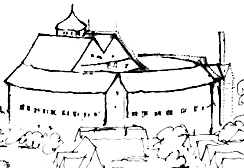
The second Globe, from Hollar's 1638 'Long View of Southwark'.

So one has to wonder who Sam might be. Sam was an American tourist, who visited London, and being (like many American tourists) a fan of William Shakespeare (but a lot smarter than the apocryphal American tourist who thought Bill was a clever dude because he used all those quotes...) went to see the monument where the Globe Theatre had been. He was shocked to find there wasn't one, only a grubby marker.

The New York Times:
On his first visit to London in 1949, he had sought traces of the original theater and was astonished to find only a blackened plaque on an unused brewery.

He decided to do something about it. He was Sam Wanamaker, actor, director, and clearly a visionary. The NY Times again:
He found this neglect inexplicable, and in 1970 launched the Shakespeare Globe Trust, later obtaining the building site and necessary permissions despite a hostile local council. He siphoned his earnings as actor and director into the project, undismayed by the skepticism of his British colleagues.

The world has another Globe in it, where it should be - on the south side (the better side) of the Thames. And now there's a marker there for Sam, voted for by 'the people'.

Sam's spot. James.

Shakespeare's Globe is a magnificent piece of experimental archaeology; one of the most critical sites for the understanding of humanity on the planet, and a bargain day out for a tourist in London - with, if you time it right, a gloss of culture and art and history over a ribald, rattling good evening out and tall tales and swordfights enough for anyone. Not to mention patter enough to knock a rapper.

From Wiki:
While many had said that the Globe reconstruction was impossible to achieve, he persevered for over twenty years, and eventually a new Globe theatre was built according to a design based on the research of historical advisor John Orrell.
Shakespeare's Globe at night, 2008. James.

I'm no ardent fan of Shakespeare; the shadow he casts over English is too large too allow any debate, not a territory I like; but he has a number of things going for him that don't usually make the list. He saw, like many of his time, spelling as a convenience, not a rule, and stretched and kicked-wider English to the extent he is the single most quoted author in the language. (Most people would think of the great declamations, but in fact most of us use will a Shakespeare quote a day without even realising. He is in the very warp and weft of our language.) His spelling is so appealing to a poor speller like me right down to not even spelling his name consistently in the few of his signatures we have. (A fascinating insight to them here.)

'Why are we waiting?' Groundings (And band) pre-performance. James.

We have visited the Globe on many occasions; in fact it was a given stop on our return to the UK last year (and some of the pics are from then - and a great evening out with friends and ex- colleagues Xanthe and Nick) and we have been lucky enough to 'introduce' many friends and family to this theatre.

It would be simplistic to assume that what you get is theatre in Shakespeare's day. It is not, and cannot be; but it is as live as Shakespeare's theatre must have been, with a passing jet airliner or incautious move by a 'groundling' worked into the day's performance by the cast, and theatre where the audience are integral to the story. It is as close as we can get, within reason.

Take a bow. James.

Shakespeare obviously did not live to see the hold his plays would have on the world. Sadly Sam Wanamaker didn't live to see the new Globe completed, either, but I'd hope he realised what a tremendous achievement it is.

Even it's making is of note. It's the first thatched building allowed in London since the Great Fire (for which, of course, there was already a monument in 1970...) and the first thatched building in London to have a sprinkler system fitted - on the outside. But most important of all, it's heart is of English oak - a wooden wall of art.


James