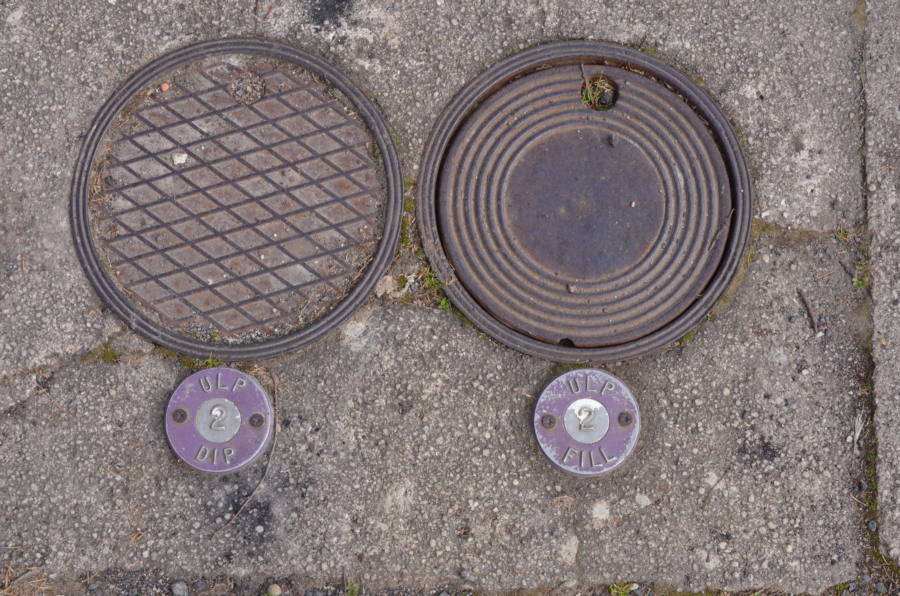
The market, held every Sunday, in Kongwak, Gippsland (it's not even really a village, since the dairy closed) and is we're told, very popular, and it was full of people - none of whom are in this post. This is a shot of the shed's roof and wall.
Door. The Newport's the UK one.
Sort of essential, now not.
The Comet racer, heading into shadow-cloud...
Assemblage 1.
I like the idea of a slow motion slide button... On an Elmo 8mm projector.
Assemblage 2.
Fonts and missing bits.
Not for dusting the dairy.
Colonised gutter.
Yet now the whole building is heading to waste.
Used to be a filling station outside the general store.
James
Showing posts with label Aviation. Show all posts
Sunday, July 7, 2013
Kongwak Market
Labels:
architecture,
Art,
Aviation,
books,
ceramics,
Conservation,
creative,
diversity,
Film,
friends,
fun,
History,
James,
Markets,
Odd Stuff,
photography,
rambles,
Technology,
thrifting,
Trivia
Wednesday, May 1, 2013
Space! The flight's delayed...
I really like the latest* cover of the New Yorker.
I like the slightly retro look and feel, but what makes it special is the juxtaposition of the spaceport outside (Kids! It's the future!) and the all-too-familiar airport lounge (Kids! Stop running around!**) the two separated by the humongous architect's windows.
They can make big windows in the airport, but the 'planes are still late. What do you think space travel will become like? Mundane, just like air travel did.
The facts are the image is Luke Pearson's 'Now Boarding', details and background on the New Yorker's website here.
James
*Latest here - that's two issues ago to New Yorkers.
**To be fair, while the kids are running in the pic, there's no conflict pictured in the lounge. I just projected that.
I like the slightly retro look and feel, but what makes it special is the juxtaposition of the spaceport outside (Kids! It's the future!) and the all-too-familiar airport lounge (Kids! Stop running around!**) the two separated by the humongous architect's windows.
They can make big windows in the airport, but the 'planes are still late. What do you think space travel will become like? Mundane, just like air travel did.
The facts are the image is Luke Pearson's 'Now Boarding', details and background on the New Yorker's website here.
James
*Latest here - that's two issues ago to New Yorkers.
**To be fair, while the kids are running in the pic, there's no conflict pictured in the lounge. I just projected that.
Thursday, April 7, 2011
Airtruk
Seen on the weekend at the Antiquers Echuca Airshow, the unique Transavia Airtruk.
They don't make them like that anymore - or before.
Wednesday, March 30, 2011
Next instalment
So, mention of long tresses in my last post because yesterday I went and plocked down in a chair at the local ladies salon and said "Cut it all off." Which they did. I must be mad, winter's coming. But I'm happy!
Meanwhile, up in the skies, the lads seem to be having a fine old time.
The dog and I have just lit a fire (he supervised from a safe distance) and we're about to do some quilting. At least, I'll operate the needle and quilt; he'll operate the zzzZZzzz noises.
B
Meanwhile, up in the skies, the lads seem to be having a fine old time.
The dog and I have just lit a fire (he supervised from a safe distance) and we're about to do some quilting. At least, I'll operate the needle and quilt; he'll operate the zzzZZzzz noises.
B
Fly by
So, I got a noisy phone call. REALLY noisy. And yet, somewhere in all the buzzing and loud droning, I could hear the happy yells of my lovely husband.
"Go outside in ten minutes!" he shouted, "Look up."
Sure enough.

I waved my straw hat down in the big green paddock feeling like some dame in some 1940s movie.
The fingers of the wind tossed my long tresses and I turned around to share the moment with .... the dog, uninterested, sniffing with intention at a shrub.
Oh well.
Have fun, lads!
B
"Go outside in ten minutes!" he shouted, "Look up."
Sure enough.

I waved my straw hat down in the big green paddock feeling like some dame in some 1940s movie.
The fingers of the wind tossed my long tresses and I turned around to share the moment with .... the dog, uninterested, sniffing with intention at a shrub.
Oh well.
Have fun, lads!
B
Sunday, January 23, 2011
Lysander Wordle
This 'Wordle' is based on my Lysander book's text. It's a kind of summary, but I'm not sure it does proper credit to the research. Still, it looks pretty. A bit like writing the book, it's rendering down a huge amount of information into a much smaller, easier format. This does that all over again.James
Thursday, October 7, 2010
Kestrel
Although not much chop as a photo, here's a shot of 'our' local kestrel, as it was buzzed by another smaller bird who was obviously not impressed at the turf the kestrel had chosen.

I'd been watching it as it hovered, in a stiffish breeze, and for seconds at a time, it didn't flap the wings at all. That's an amazing effort, balancing the four forces* so perfectly. (It's equivalent to a person walking on a medicine ball while it rolls down a bumpy hill - blindfold (you can't 'see' air, remember?).) Despite all the much vaunted capability of modern aircraft, fly-by-wire computers, variable geometry et al, we don't have anything that can do this without a lot of pilot skill or using a lot of energy - a lot more than muscle power for certain.
James
*Lift, Thrust, Weight & Drag - here.

I'd been watching it as it hovered, in a stiffish breeze, and for seconds at a time, it didn't flap the wings at all. That's an amazing effort, balancing the four forces* so perfectly. (It's equivalent to a person walking on a medicine ball while it rolls down a bumpy hill - blindfold (you can't 'see' air, remember?).) Despite all the much vaunted capability of modern aircraft, fly-by-wire computers, variable geometry et al, we don't have anything that can do this without a lot of pilot skill or using a lot of energy - a lot more than muscle power for certain.
James
*Lift, Thrust, Weight & Drag - here.
Thursday, September 2, 2010
Dit dit dah...
Labels:
Aviation,
History,
James,
One pic post,
Technology,
War
Thursday, February 11, 2010
Sky yacht
High observation deck?

Thanks to the photo archives at LIFE magazine, another period post on my Vintage Aero Writer blog. Pop over for a look at a unique yacht and an early example of the bikini.
James

Thanks to the photo archives at LIFE magazine, another period post on my Vintage Aero Writer blog. Pop over for a look at a unique yacht and an early example of the bikini.
James
Friday, January 22, 2010
Airlifts - Berlin to Haiti
Image by C-130 Hercules Flight Engineer Mark..
I'm sure all our readers will be well aware of the tragic events over the last week in Haiti. Over on my aviation writing blog here, I've put up a comparison of the current airlift into Port au Prince with the 1948-9 Berlin Airlift. While they are very different events, the historical comparisons and the importance and limitations of aviation in these airlifts is, I think, of interest.
Berliners watching a C-54 land at Berlin Tempelhof Airport, 1948. United States Air Force Historical Research Agency via Cees Steijger.There has been a good deal broadcast over the issues at Port au Prince, but I was privileged to obtain some aircrew first hand accounts of the current efforts in Haiti, particularly in detail from my friend Brad Pilgrim, a loadmaster on a United States Air Force (USAF) C-17 transport aircraft. These insights are not the kind of thing that makes the news - the news version's nice and tidy (and perhaps less technical) and those trying to address Haiti's problems haven't got time to hear the stories. But you might like to gain an insight what it's like to ride alongside some of these crews, and what are some of the real problems and successes.
Above: The ramp at Port au Prince Haiti. (US Defense. A high res version of the image is available here.) On this ramp area is a remarkable variety of aircraft. Some are familiar to us all from airports, others, like the US Coast Guard Hercules less so, and in the middle of the photo is an upright white tail between two grey ones. That's a C-54, one of the types used over half a century ago to save Berlin - as seen in the black and white image above.I'll hand over to Brad. These views are his own, not official USAF or similar, and certainly worth sharing;
I landed there last night. I unloaded 130,000 pounds of rolling stock and food. We expected to carry out 250+ passengers. We were told that no passengers were on site. While we were getting ready to leave, a guy ran up and asked how long we could wait. I checked with my pilots and told him we had about an hour. He said a bunch of passengers had just shown up unexpectedly and they wanted to put them with us. I told him to get me as many as they could. ...
Brad Pilgrim. I'd just like to publicly thank Brad and the others who responded to my request for feedback, and for their work in extraordinary challenging times. Read their stories in my other post here.
James
Saturday, January 2, 2010
When 'boats flew with elegance & style
All I wanted for Christmas was a new two-hundred mile an hour two-deck Imperial Flying Boat!

Two posters from the Smithsonian: 'Fly Now: The National Air and Space Museum Poster Collection'. This one is an interesting variation on the period's aviation posters with a forced perspective to imitate the unbelievably high bow of the luxury transatlantic liners of the day, most famous with the Normandie poster.
The Smithsonian's blog about this collection is here, and the posters are here.

The right crowd and no crowding. Glad to see the little girl has to stand on tiptoe to see the elephants stampeding below. As you'd expect, while the physical shapes of some of the passengers are biologically impossible, the decor is absolutely accurate.
James
___________________________________________
Top:
Sponsor: Imperial Airways
Artist: Severin
Inventory Number: A19901003000
Country of Origin: United Kingdom
Dimensions: Unframed: 100.97 x 63.5cm (3ft 3 3/4in. x 2ft 1in.)
Materials: Offset Lithograph
Physical Description: IMPERIAL AIRWAYS Multicolor commercial aviation print. Seaplane (Short S.23 Empire Flying Boat, G-ADHL) in harbor with what appears to be tugboats on either side of it. Rear view of seaplane. Multicolor, but mostly blue and white image on paper. Partial text: "Imperial Airways Europe Africa India Far East Australia"
Lower:
Sponsor: Imperial Airways
Manufacturer: Haycock Press
Artist: Chandler
Date: 1936
Country of Origin: United Kingdom
Dimensions: Unframed: 49.53 x 31.75cm (1ft 7 1/2in. x 1ft 1/2in.)
Materials: Offset Photolithograph/Letterpress
Physical Description: Interior scene of Short Empire flying-boat (Short S.23); well-dressed passengers read, drink wine, look out window at a coastal scene, text block at bottom; multicolor image on paper. Full text: Luxury in the new Emprie Flying Boats Imperial Airways Europe, Africa, India, China, Australia

Two posters from the Smithsonian: 'Fly Now: The National Air and Space Museum Poster Collection'. This one is an interesting variation on the period's aviation posters with a forced perspective to imitate the unbelievably high bow of the luxury transatlantic liners of the day, most famous with the Normandie poster.
The Smithsonian's blog about this collection is here, and the posters are here.

The right crowd and no crowding. Glad to see the little girl has to stand on tiptoe to see the elephants stampeding below. As you'd expect, while the physical shapes of some of the passengers are biologically impossible, the decor is absolutely accurate.
James
___________________________________________
Top:
Sponsor: Imperial Airways
Artist: Severin
Inventory Number: A19901003000
Country of Origin: United Kingdom
Dimensions: Unframed: 100.97 x 63.5cm (3ft 3 3/4in. x 2ft 1in.)
Materials: Offset Lithograph
Physical Description: IMPERIAL AIRWAYS Multicolor commercial aviation print. Seaplane (Short S.23 Empire Flying Boat, G-ADHL) in harbor with what appears to be tugboats on either side of it. Rear view of seaplane. Multicolor, but mostly blue and white image on paper. Partial text: "Imperial Airways Europe Africa India Far East Australia"
Lower:
Sponsor: Imperial Airways
Manufacturer: Haycock Press
Artist: Chandler
Date: 1936
Country of Origin: United Kingdom
Dimensions: Unframed: 49.53 x 31.75cm (1ft 7 1/2in. x 1ft 1/2in.)
Materials: Offset Photolithograph/Letterpress
Physical Description: Interior scene of Short Empire flying-boat (Short S.23); well-dressed passengers read, drink wine, look out window at a coastal scene, text block at bottom; multicolor image on paper. Full text: Luxury in the new Emprie Flying Boats Imperial Airways Europe, Africa, India, China, Australia
Wednesday, December 30, 2009
60 Years of Lego Part 1

The plastic brick building system Lego was developed 60 years ago in Denmark in 1949. In the first of two parts about this remarkable toy, I was lucky enough to be able to interview Joseph, my local Lego expert, aged nine.
Taccola: What’s your favourite Lego set?Joseph: The Dino Attack Helicopter.
T: How long have you had it?
J: Two or three years.
T: Why is it your favourite?
J: Because it’s big, and I like big sets, and it’s long so it’s easy to carry and it’s not delicate.
Indiana Jones Flying Wing
T: What’s your favourite single piece?
J: The wing from the Indiana Jones Lego Set ‘Fight on the Flying wing’. It’s the biggest piece. I bought this one with my own money.
T: Why is Lego good stuff?
J: Because you build it, and then you can play with it and the characters, or you can break it and build it again.
T: How many Lego sets do you have?
J: Around 30.
T: How old were you when you got your first Lego set, and what was it? J: About six – it was an old style set called ‘Wookie Attack’. I’m nine now.
T: What’s the smallest piece you’ve got?
J: Probably the single round flat piece.
T: What’s the biggest thing you’ve made that is your own design or invention?
J: Dino Attack Base.
T: How did you design it?
J: I broke most of my Dino Attack Lego, and then I got the tracks from the tank and attached them to the base that I built and then I built onto it. I put stuff onto it that I liked like cannons and characters.
T: What is the most important thing about Lego?
J: That it’s not Mega Bloks! It’s bits and pieces – it’s not just one thing.
T: What’s the biggest Lego set in the world?
J: The $1,000 dollar Millennium Falcon limited edition.
T: What’s your favourite type of Lego?
J: Star Wars Lego – not the Clone Wars, the older type.
T: What Lego do you want next?
J: There’s a few; the AT-AT Walker; the Dino Attack jeep thing; the Ahsoka Starfighter and droids and the Hailfire droid.
T: What do you think you’ve learned from using Lego?
T: Everything I know about Star Wars!
Building Bionicles in a couple of minutes. Building Lego much quicker and not needing any help.
T: What don’t you like about Lego?
J: Nothing except the new style the Clone Wars – because they have the worst designs and the characters with big eyes.
T: Would you like to go to Legoland in Denmark?
J:Yes!
T: Thank you Joseph!
Saturday, December 26, 2009
Women & radio wars - the Y Service's 'Corona'
Some aspects of warfare throw up the most bizarre events, even though the sequence leading to it might seem rationally inevitable.
Who would expect a British woman of reducing a German woman to fits of giggles (and to collapse from laughter herself) in the middle of one of the bloodiest battles of World War II?
In the latter part of that war, the night skies over Germany became a new kind of battleground where the aircraft of the RAF's Bomber Command were tackled by the night fighter aeroplanes of the German air force, the Luftwaffe. It was a bloody war with (in some measures) as much attrition on both sides as the Western Front in the Great War of 1914-18.
But this was a new kind of war in other ways.
It was the first war that was invisible, but as hard-fought as hand-to-hand combat; where men, and women, remote from the fighting, strove to give their colleagues an edge or advantage. And those advantages swung back and forth dependant on the newest technology, but also on the most unlikely of skills, and where only words and very quick wits were sometimes as powerful as other weapons. This was the war of the 'specials' -- now called electronic warfare -- but then a secret art known to few.
Radio operators in action in this uncaptioned Imperial War Museum image. (IWM)
These men and women were cramped into tiny rooms in the air or on the ground, staring intently into cathode ray tubes and manipulating dials, while their arena was huge - from Southern Britain to Eastern Germany.
One particular aspect of this was the 'Y service' where German speakers (men and women) were recruited in Britain to sit in cramped quarters and listen in (on captured German aircraft radios, where possible), eavesdropping on German transmissions between the night fighter crews and their ground-based controllers. Initially listening was all they did, using the information to revise counter strategies, but in a unique twist, the British based operators could intervene. The BBC, GPO (Post Office) and the RAF developed 'high power transmitters that bounced signals off the ionosphere deep into Germany.'
The Lancaster I NG128 dropping its load over Duisburg on Oct 14, 1944. The aircraft is carrying Airborne Cigar (ABC) radio jamming equipment, as shown by the two vertical aerials on the fuselage. (RAF Pathfinder Museum)
Another ingredient was an extra man aboard a Lancaster, using very secret radio equipment codenamed 'Airborne Cigar' or ABC. Peggy West, one of the women operators, tells us the story:
An 'atmospherically lit' Messerschmitt Bf 110 night fighter, one of the Luftwaffe's main types in the role, in the RAF Museum, Hendon. Author.
The British had an operator aboard a Lancaster jamming (or distracting) German ground transmissions. To 'spoof' them, he might work with a British operator broadcasting in German, from Kingsdown while pretending to be the 'real' German controller. Confusing? Very.
An uncaptioned photograph of a woman operator - probably radar rather than radio - on the Imperial War Museum website. (IWM)
So the real female German controller had a British based female 'spoof' controller relayed onto her German wavelength to distract and misdirect her and her night fighter crews. The frustration of the previously-mentioned male German controller was encountered by his female successor:
James
Peggy West's account of the work of the Y Service can be found here, as part of a 2003 conference on the Air War in Europe at the Australian War Memorial. More on the Y Service on this page from The Secret War's website, and some of the background to the RAF's special aircraft can be found here on 100 Group. More firsthand memories on the excellent BBC People's War Website can be found here, with an ABC Operator and a WAAF Y Service operator.
Who would expect a British woman of reducing a German woman to fits of giggles (and to collapse from laughter herself) in the middle of one of the bloodiest battles of World War II?
In the latter part of that war, the night skies over Germany became a new kind of battleground where the aircraft of the RAF's Bomber Command were tackled by the night fighter aeroplanes of the German air force, the Luftwaffe. It was a bloody war with (in some measures) as much attrition on both sides as the Western Front in the Great War of 1914-18.
But this was a new kind of war in other ways.
It was the first war that was invisible, but as hard-fought as hand-to-hand combat; where men, and women, remote from the fighting, strove to give their colleagues an edge or advantage. And those advantages swung back and forth dependant on the newest technology, but also on the most unlikely of skills, and where only words and very quick wits were sometimes as powerful as other weapons. This was the war of the 'specials' -- now called electronic warfare -- but then a secret art known to few.
Radio operators in action in this uncaptioned Imperial War Museum image. (IWM)These men and women were cramped into tiny rooms in the air or on the ground, staring intently into cathode ray tubes and manipulating dials, while their arena was huge - from Southern Britain to Eastern Germany.
One particular aspect of this was the 'Y service' where German speakers (men and women) were recruited in Britain to sit in cramped quarters and listen in (on captured German aircraft radios, where possible), eavesdropping on German transmissions between the night fighter crews and their ground-based controllers. Initially listening was all they did, using the information to revise counter strategies, but in a unique twist, the British based operators could intervene. The BBC, GPO (Post Office) and the RAF developed 'high power transmitters that bounced signals off the ionosphere deep into Germany.'
The Lancaster I NG128 dropping its load over Duisburg on Oct 14, 1944. The aircraft is carrying Airborne Cigar (ABC) radio jamming equipment, as shown by the two vertical aerials on the fuselage. (RAF Pathfinder Museum)Another ingredient was an extra man aboard a Lancaster, using very secret radio equipment codenamed 'Airborne Cigar' or ABC. Peggy West, one of the women operators, tells us the story:
Then in October 1943 something quite different was introduced – 'Corona'. At Kingsdown, using those high power transmitters to reach far into enemy country, specially selected men and women began annoying voice interference on the 3–6 megacycle range. Pseudo controllers issued false tuning counts to prevent the Luftwaffe going operational, gave false fog warnings to get aircraft to land, read poetry, or relayed Hitler’s speeches to disrupt and frustrate, and gave direct, contrary orders to cause confusion.Sam Brooks (on the BBC 'People's War' website) remembers:
The Germans tried all manner of devices to overcome the jamming, including having their instructions sung by Wagnerian sopranos. This was to fool our operators into thinking it was just a civilian channel and not worth jamming.Back to Peggy:
Corona led to some amusing incidents. A German controller was trying to direct his aircraft to Kassel. Kingsdown’s 'ghost' was trying to stop them and told them not to take any notice of the Englander who was trying to confuse them. After an exchange or two, the German became pretty agitated, lost his temper, and swore. Our 'ghost' replied, “The Englander is now swearing” and was met by an infuriated shriek from Germany: “It's not the *%$#@$ Englander who is swearing, it's *%$#@$ me”!
An 'atmospherically lit' Messerschmitt Bf 110 night fighter, one of the Luftwaffe's main types in the role, in the RAF Museum, Hendon. Author.The British had an operator aboard a Lancaster jamming (or distracting) German ground transmissions. To 'spoof' them, he might work with a British operator broadcasting in German, from Kingsdown while pretending to be the 'real' German controller. Confusing? Very.
When a 101 Squadron Lancaster with its ABC 'Special' was shot down over Berlin, the Luftwaffe assumed Kingsdown’s 'Corona' voice interference came from that ABC equipment. They reasoned, correctly, that the RAF would not allow women to fly operationally over Germany and switched to women ground controllers. Since we had anticipated that, we did the same.
An uncaptioned photograph of a woman operator - probably radar rather than radio - on the Imperial War Museum website. (IWM)So the real female German controller had a British based female 'spoof' controller relayed onto her German wavelength to distract and misdirect her and her night fighter crews. The frustration of the previously-mentioned male German controller was encountered by his female successor:
One of our girls got into a similar battle of wills, the only difference being that both women ended up laughing with each other and had to shut down. We all enjoyed the incident very much – but did wonder what happened to the lass over there!Such moments of bizarre amusement were few in such a terrible war, but who could ever have predicted such an event ever coming to pass?
James
Peggy West's account of the work of the Y Service can be found here, as part of a 2003 conference on the Air War in Europe at the Australian War Memorial. More on the Y Service on this page from The Secret War's website, and some of the background to the RAF's special aircraft can be found here on 100 Group. More firsthand memories on the excellent BBC People's War Website can be found here, with an ABC Operator and a WAAF Y Service operator.
Thursday, October 22, 2009
75 years ago...
Ray Parer
C.W.A. Scott and Tom Campbell Black.
Captain K.D. Parmentier, First Officer J.J. Moll....these well-dressed young men (and several other men and women) were on their way to Australia from Mildenhall, England. What were they doing?
For more, see: Vintage Aviation Writer. Pictures from the Flight Global archive.
James
Labels:
Aviation,
England,
History,
James,
Melbourne,
photography,
Technology,
Transport,
Travel
Friday, October 2, 2009
Stalin's waiting
There's something rather eerie about the idea of a holiday in Stalin-era Russia.
Poster from the Boston Public Library Flickr Set here.
Presumably people did, as well as Reuters reporters like Ian Fleming arriving to cover things like the Metro-Vickers' show trial of 1933.
The aircraft, a generic type not uncommon in advertising, looks like a rough approximation of a German Junkers type crossed with a Dutch Fokker. Junkers was one of the aircraft companies the Germans had working in Russia when they were prevented from building them in Germany by the Versailles Treaty. Seemed like a good idea at the time, but I think it was an arrangement both the Russians and Germans later came to regret.
Poster from the Boston Public Library Flickr Set here.Presumably people did, as well as Reuters reporters like Ian Fleming arriving to cover things like the Metro-Vickers' show trial of 1933.
The aircraft, a generic type not uncommon in advertising, looks like a rough approximation of a German Junkers type crossed with a Dutch Fokker. Junkers was one of the aircraft companies the Germans had working in Russia when they were prevented from building them in Germany by the Versailles Treaty. Seemed like a good idea at the time, but I think it was an arrangement both the Russians and Germans later came to regret.
Wednesday, July 15, 2009
What's in the Box?
So what's in the box?
On the other side it says 'Business Cards'. Could be a clue.
Yup, it's cards! Moo do good stock business cards in full colour on both sides. They're not cheap, but they are good. (And who wants business cards that look cheap?)
You can use their designs, or your own - for my work, pictures of aircraft that I've taken aren't hard to come by, and with a bit of careful selection, we can make a wall of cards...
LOTS of cards! Only problem is I don't want to give them out. Oh, and the other only problem I know from previous experience is people find it hard to choose which card they want...We've now used Moo several times, and are very happy with the service, as are our friends who have also used them. It seems a bit odd buying cards at a US dollar price from the UK to ship to Australia, but it works. The small business cards (MiniCards) are fun things too. The turnaround was very quick.
A fun parcel to open.
James
(Moo is at www.moo.com - no we aren't getting anything for recommending them, we just reckon they're worth passing on.)
Tuesday, April 7, 2009
Here there (used to) be monsters
A view of Windemere from our 2008 Lakes visit. BThe Lake District in the UK has a fascinating, complex, layered history, and is one of our favourite spots in Britain - not least because it has mini-Rockies in it, good for a Canadian's heart.
Is there one of these* monsters...One of the most secret bits is the fact that there was a big aeroplane factory** there during W.W.II. Some time ago I hooked up with Allan King, online, and last year, when Bev and I were visiting the area, we were able to finally meet Alan and have a very nice lunch. Allan had been researching the story of this essentially forgotten factory, and the local people involved, for many years. There was a Loch-Ness-aeroplane story involved, and Allan has the answer...
...lurking under here? JWe (MMP, my publishing company) were able to publish Allan's book, which is now out, and thanks to Allan's PR skills, he scored a signing session at the local Waterstones and a feature in a spot on the BBC, available on the website, here, where Allan reveals the solution.
Well done Allan.
If you can pop by to see the exhibition at the Visitor's Centre at Brockhole, please do, otherwise you might like to buy this very fine book, from here. [shameless plug]
James
*The Short Sunderland in the Imperial War Museum, Duxford. One of all too few survivors. **It was a small factory for big aeroplanes, or a big factory for big aeroplanes, depending on your point of view. The Sunderland is a beautiful but big flying boat, and capable of lurking like a behemoth. Monstrous any which way.
Subscribe to:
Posts (Atom)


