
...that left this boat on a local dam. We're a good 50 kilometres from Port Philip Bay and about double that to the coast.

James
 A water gate and window box achieving an Italian flag effect.
 Candleholder for your plaque. Otherwise who is going to be scared by your wolf by night?
 The vital Venetian chimney tops to collect sparks and avoid fire. Despite all the water, fire was a major risk.
 Don't feed the cherub too much spinach.
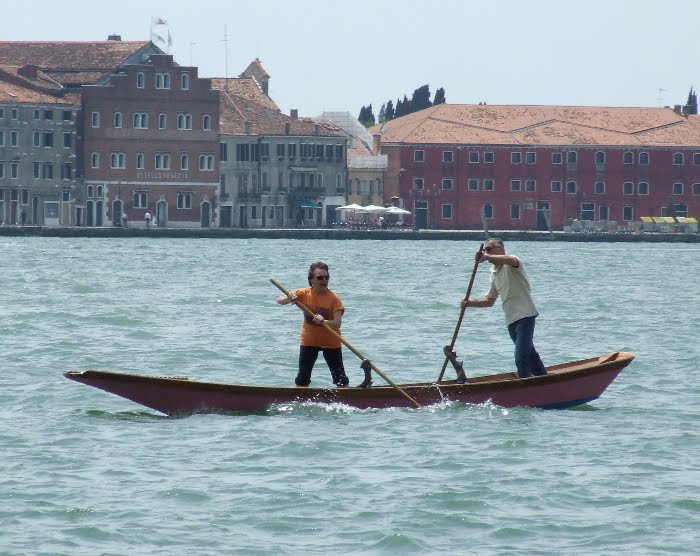 "When you said two outboard motors, I thought..."
 A delivery barge, a tree, a nap and thou...
 The original Arsenal. Interestingly this Naval shipyard is still closed to the public, but I suspect the defences of Italy aren't dependant on their products as Venice's were.
 Garden and church.
 You can't get the plasterers to finish a job properly, here.
 Church with tollbooth. Or is is an aquatic confessional?
 Bombed on the beaches, British soldiers use Lee Enfield rifles to fire back at the German Luftwaffe. (BBC.)
 Here in the Imperial War Museum, London, is one of the little ships of Dunkirk- in fact the littlest, Tamzine - sailed by amateur or professional civilian sailors that brought the soldiers off the beaches. Author.
 Today is Australia Day. It's the 222nd anniversary of the First Fleet arriving in what was to become Australia on 26 January 1788, starting the European settlement of Australia that has continued to this day. The Sydney Museum has an excellent model of the First Fleet ships on show (below) and I wonder how many of those aboard realised they were arriving in mid-summer?
 Of course the First Fleet was a direct result of the arrival of Lieutenant James Cook in His Majesty's Barque Endeavour on one of the world's great voyages of exploration. (The introductory image at the top shows the replica of HMB Endeavour sailing up the Yarra in Melbourne.) Again, an aspect of Cook's exploration of the Eastern coast of Australia and the arrival of the First Fleet is that it could so easily have been a French story, as the French Navy were literally on the spot - or in the natural harbours - at both events. While there are a scattering of French names (particularly in Tasmania - itself based on a Dutch navigator's name) it's a monolingual Anglophone culture in law. Yet it could have been like Canada, with a foot in both French and British culture and language, or a member of the Francophone world like -er- Monaco.
 Often overlooked near the Circular Quay in Sydney is this mosaic map (above) showing the very first developments of what was much later to become the city of Sydney, Australia's eternal second best conurbation.
 Of course, the First Fleet was the beginning of a social experiment that failed at its origin - to export 'the criminal class' from Britain, and to develop colonies with these prisoners. No one has yet managed to export their 'criminal class', so that part was a failure, but we seem to have managed to build quite a habitable country on this unprepossessing foundation. The convicts would try to escape from the marines and soldiers (obviously to get to what would become Victoria and Melbourne from the rather inferior Sydney and New South Wales) as seen above at Sovereign Hill historical re-enactment. But to get away they would have to get through the Blue Mountains (below) one of Australia's natural wonders which is essentially untouched except for the viewing platforms and coach parking (not included in the picture).
 And when it's been another great Australia Day here, and we are rolling home with a beaut sunset to the West, it's the start of another cold, winter's day in Britain. We've just celebrated five years and one day here, and it's bonzer, mate.
 James (a Melburnian)


 Today was a very special day. Thanks to the huge array of great things there are to do in Australia (and particularly Melbourne) on Australia Day, we were able to sample a free couple.
 First stop was the RACV Australia Day Picnic and Federation Vehicle Display. What that means is something in the order of 500 cars, bikes and trucks of all kinds back to the earliest days.
 The bling alone is something else.
 Once, car makers put out Art Deco design for the masses. Even the door handles were attractive grace-notes.
 Even sometimes outclassing the sculpture. The Picnic is in the Kings Domain Gardens, a great venue.
 My friend Brad's Merc (a topic we will return to in a later post). We stopped for a bite with Brad and Kistin and their friends, under a tree on the grass and watched the passing scene.
 Self-portrait in a wing mirror.
 And a terrific shot by Bev.
 Fred Flinstone minds the dash of an Austin aesthetic.
 While the kids and families had a blast. There is an adult in the Canadian Military Pattern truck, we think! (We saw so many cool cars and stuff we'll be returning to this in a later post or two. This is just a taster.)
 That wasn't all. There was a RACV/AFA 'Flyball' competition which Bev particularly enjoyed. As Bev's photo shows, the lady's top says, 'we have hot dogs' Some of the little guys (one Jack Russell just launched) lapped the bigger ones.
 There was Melbourne's own Enterprize replica, built here as a copy of the first ship to settle the area.
 And visiting was the 1903 Alma Doepel, which has moved to Melbourne from Port Macquarie for a major refit at Docklands over the next year or two. I think we'll be seeing a bit more of her.
 Meanwhile a young lass was having a great time zooming about on the water. Here she is just having tacked.
  We had great weather, warm, nice breeze, beautiful sun, and just perfect conditions. We got home tired and happy. This is the life.
 Above: One of the Skuldev ships in Roskilde. Below: The Sea Stallion from Glendalough, from the ship's website, as are the other Sea Stallion photographs.
 What we 'know' of the Vikings is, like much history, very partial. As well as all that raping and pillaging, they were great colonists, navigators and explorers. In addition, they had an amazing oral literary tradition, and as Jim was explaining to us the other night, a political system that has some aspects that pre-figure some of the best of what we hope for today.

 But many of the recreated ships show how much these were the highest technology of their day; weapons of war, transports, communications and, of course status too. They were built by powerful leaders, and held together a maritime empire that is little appreciated today for its size and achievement.
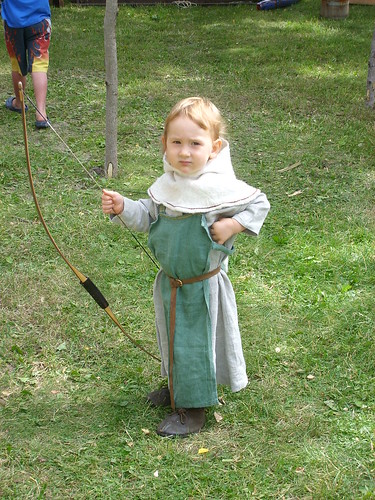 (Credit for the Sea Stallion photos and text go to the Sea Stallion website, and Eric the small to iHanna - and do have a look - they are both insights into an almost forgotten world.)
 Adela's first visit.


 The King's Library, with the move of the books to the British Library building near St Pancras, has been re-used, very well, we thought, to tell the story of the Museum and its acquisitions -


 Posts
All Comments
Posts
All Comments


