Showing posts with label Germany. Show all posts
Wednesday, December 5, 2012
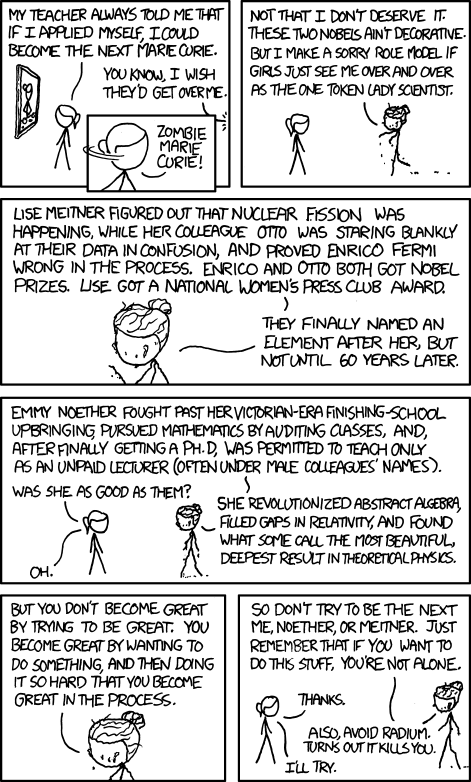
Real 'Girl Power'
As ever, xkcd.
Marie Curie
Lise Meitner
Emmy Noether
Without women like these we'd be all the poorer.
James
Labels:
Academic,
creative,
diversity,
Germany,
History,
James,
Odd Stuff,
One pic post,
Portraits,
Rants,
Technology
Wednesday, September 12, 2012
The Signs! The Signs!
If you're going to protest about English, recheck the spelling on your sign, there's a God who does nothing but strike spel.. spelli... writig on sines,
But that's an esy targit. Here's some hil.. hillari.. funni signs from The Vine. They've got 100 there, but here's an appropriate selection for our loyal readership.
Timely.
Ooooh, that's just typographically mean.
My favourite for so many reasons, but most of all for the very visible use of Tippex / Whiteout on a sign. Elsewhere*, on the misuse of history front:
Uh... You're not going to like this...
Meanwhile, in Canada's less frequented protest. ("Hey, Doug. That was against fat cats, not dogs, man.")
If nothing in the 100 makes you smile, your're probably dead. Or holding a misspelled sign on a road somewhere...
All images via The Vine.
James
*Scarily this seemed to be possibly the only sign NOT photographed in the USA.
But that's an esy targit. Here's some hil.. hillari.. funni signs from The Vine. They've got 100 there, but here's an appropriate selection for our loyal readership.
Timely.
Ooooh, that's just typographically mean.
My favourite for so many reasons, but most of all for the very visible use of Tippex / Whiteout on a sign. Elsewhere*, on the misuse of history front:
Uh... You're not going to like this...
Meanwhile, in Canada's less frequented protest. ("Hey, Doug. That was against fat cats, not dogs, man.")
If nothing in the 100 makes you smile, your're probably dead. Or holding a misspelled sign on a road somewhere...
All images via The Vine.
James
*Scarily this seemed to be possibly the only sign NOT photographed in the USA.
Saturday, August 21, 2010
Holgate's
This one's for Ross.
We had Jo and Paul up for part of the weekend, and finished with a post-lunch visit to Holgate's pub in Woodend. I was driving. Below, Bev collects the first round.
You can see other pubs with Holgate beers on tap are listed above the bar on the glass. There's even a space at the bottom for 'The Shears Inn, Halifax, W Yorkshire'.
Or maybe not.
The drinks. Left to right, pots of Hopinator, for Jo; the Holgate's Pilsner, for Bev (showing her North American and German preferences); a Lemon, Lime & Bitters for me (did I mention I was driving?); and a Mount Macedon Pale Ale for Paul.
Ready?
Cheers!
Ah. Your shout, I think!
James
We had Jo and Paul up for part of the weekend, and finished with a post-lunch visit to Holgate's pub in Woodend. I was driving. Below, Bev collects the first round.
You can see other pubs with Holgate beers on tap are listed above the bar on the glass. There's even a space at the bottom for 'The Shears Inn, Halifax, W Yorkshire'.Or maybe not.
The drinks. Left to right, pots of Hopinator, for Jo; the Holgate's Pilsner, for Bev (showing her North American and German preferences); a Lemon, Lime & Bitters for me (did I mention I was driving?); and a Mount Macedon Pale Ale for Paul.
Ready?
Cheers!
Ah. Your shout, I think!James
Saturday, December 26, 2009
Women & radio wars - the Y Service's 'Corona'
Some aspects of warfare throw up the most bizarre events, even though the sequence leading to it might seem rationally inevitable.
Who would expect a British woman of reducing a German woman to fits of giggles (and to collapse from laughter herself) in the middle of one of the bloodiest battles of World War II?
In the latter part of that war, the night skies over Germany became a new kind of battleground where the aircraft of the RAF's Bomber Command were tackled by the night fighter aeroplanes of the German air force, the Luftwaffe. It was a bloody war with (in some measures) as much attrition on both sides as the Western Front in the Great War of 1914-18.
But this was a new kind of war in other ways.
It was the first war that was invisible, but as hard-fought as hand-to-hand combat; where men, and women, remote from the fighting, strove to give their colleagues an edge or advantage. And those advantages swung back and forth dependant on the newest technology, but also on the most unlikely of skills, and where only words and very quick wits were sometimes as powerful as other weapons. This was the war of the 'specials' -- now called electronic warfare -- but then a secret art known to few.
Radio operators in action in this uncaptioned Imperial War Museum image. (IWM)
These men and women were cramped into tiny rooms in the air or on the ground, staring intently into cathode ray tubes and manipulating dials, while their arena was huge - from Southern Britain to Eastern Germany.
One particular aspect of this was the 'Y service' where German speakers (men and women) were recruited in Britain to sit in cramped quarters and listen in (on captured German aircraft radios, where possible), eavesdropping on German transmissions between the night fighter crews and their ground-based controllers. Initially listening was all they did, using the information to revise counter strategies, but in a unique twist, the British based operators could intervene. The BBC, GPO (Post Office) and the RAF developed 'high power transmitters that bounced signals off the ionosphere deep into Germany.'
The Lancaster I NG128 dropping its load over Duisburg on Oct 14, 1944. The aircraft is carrying Airborne Cigar (ABC) radio jamming equipment, as shown by the two vertical aerials on the fuselage. (RAF Pathfinder Museum)
Another ingredient was an extra man aboard a Lancaster, using very secret radio equipment codenamed 'Airborne Cigar' or ABC. Peggy West, one of the women operators, tells us the story:
An 'atmospherically lit' Messerschmitt Bf 110 night fighter, one of the Luftwaffe's main types in the role, in the RAF Museum, Hendon. Author.
The British had an operator aboard a Lancaster jamming (or distracting) German ground transmissions. To 'spoof' them, he might work with a British operator broadcasting in German, from Kingsdown while pretending to be the 'real' German controller. Confusing? Very.
An uncaptioned photograph of a woman operator - probably radar rather than radio - on the Imperial War Museum website. (IWM)
So the real female German controller had a British based female 'spoof' controller relayed onto her German wavelength to distract and misdirect her and her night fighter crews. The frustration of the previously-mentioned male German controller was encountered by his female successor:
James
Peggy West's account of the work of the Y Service can be found here, as part of a 2003 conference on the Air War in Europe at the Australian War Memorial. More on the Y Service on this page from The Secret War's website, and some of the background to the RAF's special aircraft can be found here on 100 Group. More firsthand memories on the excellent BBC People's War Website can be found here, with an ABC Operator and a WAAF Y Service operator.
Who would expect a British woman of reducing a German woman to fits of giggles (and to collapse from laughter herself) in the middle of one of the bloodiest battles of World War II?
In the latter part of that war, the night skies over Germany became a new kind of battleground where the aircraft of the RAF's Bomber Command were tackled by the night fighter aeroplanes of the German air force, the Luftwaffe. It was a bloody war with (in some measures) as much attrition on both sides as the Western Front in the Great War of 1914-18.
But this was a new kind of war in other ways.
It was the first war that was invisible, but as hard-fought as hand-to-hand combat; where men, and women, remote from the fighting, strove to give their colleagues an edge or advantage. And those advantages swung back and forth dependant on the newest technology, but also on the most unlikely of skills, and where only words and very quick wits were sometimes as powerful as other weapons. This was the war of the 'specials' -- now called electronic warfare -- but then a secret art known to few.
Radio operators in action in this uncaptioned Imperial War Museum image. (IWM)These men and women were cramped into tiny rooms in the air or on the ground, staring intently into cathode ray tubes and manipulating dials, while their arena was huge - from Southern Britain to Eastern Germany.
One particular aspect of this was the 'Y service' where German speakers (men and women) were recruited in Britain to sit in cramped quarters and listen in (on captured German aircraft radios, where possible), eavesdropping on German transmissions between the night fighter crews and their ground-based controllers. Initially listening was all they did, using the information to revise counter strategies, but in a unique twist, the British based operators could intervene. The BBC, GPO (Post Office) and the RAF developed 'high power transmitters that bounced signals off the ionosphere deep into Germany.'
The Lancaster I NG128 dropping its load over Duisburg on Oct 14, 1944. The aircraft is carrying Airborne Cigar (ABC) radio jamming equipment, as shown by the two vertical aerials on the fuselage. (RAF Pathfinder Museum)Another ingredient was an extra man aboard a Lancaster, using very secret radio equipment codenamed 'Airborne Cigar' or ABC. Peggy West, one of the women operators, tells us the story:
Then in October 1943 something quite different was introduced – 'Corona'. At Kingsdown, using those high power transmitters to reach far into enemy country, specially selected men and women began annoying voice interference on the 3–6 megacycle range. Pseudo controllers issued false tuning counts to prevent the Luftwaffe going operational, gave false fog warnings to get aircraft to land, read poetry, or relayed Hitler’s speeches to disrupt and frustrate, and gave direct, contrary orders to cause confusion.Sam Brooks (on the BBC 'People's War' website) remembers:
The Germans tried all manner of devices to overcome the jamming, including having their instructions sung by Wagnerian sopranos. This was to fool our operators into thinking it was just a civilian channel and not worth jamming.Back to Peggy:
Corona led to some amusing incidents. A German controller was trying to direct his aircraft to Kassel. Kingsdown’s 'ghost' was trying to stop them and told them not to take any notice of the Englander who was trying to confuse them. After an exchange or two, the German became pretty agitated, lost his temper, and swore. Our 'ghost' replied, “The Englander is now swearing” and was met by an infuriated shriek from Germany: “It's not the *%$#@$ Englander who is swearing, it's *%$#@$ me”!
An 'atmospherically lit' Messerschmitt Bf 110 night fighter, one of the Luftwaffe's main types in the role, in the RAF Museum, Hendon. Author.The British had an operator aboard a Lancaster jamming (or distracting) German ground transmissions. To 'spoof' them, he might work with a British operator broadcasting in German, from Kingsdown while pretending to be the 'real' German controller. Confusing? Very.
When a 101 Squadron Lancaster with its ABC 'Special' was shot down over Berlin, the Luftwaffe assumed Kingsdown’s 'Corona' voice interference came from that ABC equipment. They reasoned, correctly, that the RAF would not allow women to fly operationally over Germany and switched to women ground controllers. Since we had anticipated that, we did the same.
An uncaptioned photograph of a woman operator - probably radar rather than radio - on the Imperial War Museum website. (IWM)So the real female German controller had a British based female 'spoof' controller relayed onto her German wavelength to distract and misdirect her and her night fighter crews. The frustration of the previously-mentioned male German controller was encountered by his female successor:
One of our girls got into a similar battle of wills, the only difference being that both women ended up laughing with each other and had to shut down. We all enjoyed the incident very much – but did wonder what happened to the lass over there!Such moments of bizarre amusement were few in such a terrible war, but who could ever have predicted such an event ever coming to pass?
James
Peggy West's account of the work of the Y Service can be found here, as part of a 2003 conference on the Air War in Europe at the Australian War Memorial. More on the Y Service on this page from The Secret War's website, and some of the background to the RAF's special aircraft can be found here on 100 Group. More firsthand memories on the excellent BBC People's War Website can be found here, with an ABC Operator and a WAAF Y Service operator.
Saturday, April 11, 2009
Why kids' books are important
I would say that children's books are the most consistently under-rated type of book. A moment's thought would indicate how powerful an effect they can have, and most of us will remember certain childhood books in ways 'more important' literature fails to stick as it drains from the memory. A successful children's book will achieve classic status in a way few other books ever can.

Recently, I was making a list of the greats in kids books. To make it harder, I had to pick just one from each country I could think of. Some were shoo-ins, others fought hard to squeeze into the niche. And then there are those that were the result of a multi-national background. I was aware that Eric Carle's The Very Hungry Caterpillar was from a German-American, and so much of what it is comes from his background, but I didn't realise how much of it. This recent Guardian interview (well worth reading in total) takes us through the story behind the story. And it's an amazing one.
Carle, like many who have seen the worst in the world (he was forced to dig the Sigfried Line as a 15 year old, with people dying around him) appreciates the motivation deprivation gives, something the affluent don't have. Like many authors his work comes, in part, from his old environment;
Eric Carle. Photograph: Maggie Steber, via The Guardian.
As ever, the involvement of others than the author was critical; and discipline in content another critical factor:
But the story makes the best-seller for lots of reasons; one key one, according to Carle (here on the Penguin Books website) makes a lot of sense to me:
James

Recently, I was making a list of the greats in kids books. To make it harder, I had to pick just one from each country I could think of. Some were shoo-ins, others fought hard to squeeze into the niche. And then there are those that were the result of a multi-national background. I was aware that Eric Carle's The Very Hungry Caterpillar was from a German-American, and so much of what it is comes from his background, but I didn't realise how much of it. This recent Guardian interview (well worth reading in total) takes us through the story behind the story. And it's an amazing one.
Carle, like many who have seen the worst in the world (he was forced to dig the Sigfried Line as a 15 year old, with people dying around him) appreciates the motivation deprivation gives, something the affluent don't have. Like many authors his work comes, in part, from his old environment;
For his first six years, Carle lived in upstate New York with his parents, who had emigrated from Germany. In the mid-30s his mother, homesick, took the family back to Stuttgart at a time when everyone was trying to move the other way. War broke out, his father was drafted into the German army and spent eight years as a prisoner of the Russians. Before the war, he had been his son's great ally, a gentle man, an amateur artist. When he came back, he was broken. Carle turns over the memories of this period slowly. He is very careful to get things right.And art, as so often was important - perverted for power or (as the Nazis had it) 'degenerate':
His mother was supportive of her son's love of art - "in awe" of it, in fact - but was in other ways a rather distant figure. She was not a "warm" individual. "She was a good mother. But ... I hate to say this... I loved her, she was responsible, she was good ... But I don't have this feeling which I have towards my father, as something incredibly deep. When I was little, from the beginning, he read the funny papers to me, told me stories, drew pictures, went for walks. Telling stories and walking and stopping and looking; nothing terribly important. But that has been so important in my life. The older I get, the more I know that's so true."
Carle was 10 when his father left for the army and 18 when he came back, "this sick man. Psychologically, physically devastated." Did he try to coax him back to his old self? "We didn't talk any more much. Only superficial things. I had other interests. I was in art school, an artist. I was interested in women." He puffs out his chest in parody of his 18-year-old self. "This old man, coming from Russia, we got along without you." That's pretty much how it felt, he says. "It's so sad."
The other seminal figure in his childhood was Herr Kraus, his high school art teacher, who at great personal risk noticed Carle's talent and invited him to his house to look at banned art; in Carle's memory, it was Klee, Matisse and Picasso, but he can't be sure. Anyway, it was expressionist and it made a profound impression on him. "I didn't have the slightest idea that something like that existed, because I was used to art being flag-waving, gun-toting Aryans - super-realistic Aryan farmers, the women with their brute arms. That was art. Of course. That was a shock."
Eric Carle. Photograph: Maggie Steber, via The Guardian.As ever, the involvement of others than the author was critical; and discipline in content another critical factor:
The Very Hungry Caterpillar was initially conceived of by Carle as a hungry bookworm, eating its way through the pages. His long-time editor, Ann Beneduce, wasn't sure about a worm as a central character and suggested a caterpillar. "Butterfly!" exclaimed Carle, and so it was born.It's easy to project meanings into these books. As vehicles for acorn imaginations, they can be a lot of things. Adults, as ever, can be pretty crude.
"I often joke," he says, "that with a novel you start out with a 35-word idea and you build out to 35,000 words. With a children's book you have a 35,000-word idea and you reduce it to 35. That's an exaggeration, but that's what's taking place with picture books."
The book's success has spawned a lot of crank interpretations. It has been described as an allegory of both Christianity and capitalism. "Right after the Wall fell, I was signing books in the former East Germany and was invited by a group of young librarians to have lunch with them. One said the caterpillar is capitalist, he eats into every food one little bit and then the food rots away. Wasteful capitalist. Interesting. I think that if you're indoctrinated, that's how you will see it."As a kid myself, I was never a fan of The Very Hungry Caterpillar; my graphic requirements from books were always more stringent than the rough-edged collage of Carle. I may not have been a fan, but I can certainly respect the achievement. It remains a justified best-seller.
But the story makes the best-seller for lots of reasons; one key one, according to Carle (here on the Penguin Books website) makes a lot of sense to me:
The success of my books, I think is also due to their emotional impact. Caterpillar, for instance, is a book of hope. It says that you too - an ugly, little thing - will open your wings and fly. Kids who are insecure and young identify with that."Insecurity? They know that the future is unwritten, and who knows what current activities will help them in the future. Perhaps they are just more realistic about life's potential.
James
Friday, August 22, 2008
Munich's windows
We've unjustly neglected Munich, one of the trip's many highlights. I'd never been to Germany before, and Bev hadn't been to Southern Germany before, so it was to some degree new territory for both of us. A later post will cover some other aspects, but this is all about the shop windows - why? Why not.
Having been involved in window display professionally for many years, I do like to see an effective effort - this was simple, but worked well.
The sculpture is just drawn onto the white paper-covered boxes by marker pen.
Then there's the antique shop windows. A selection of odd items:
"You aren't leaving the mousehole dressed like that are you?" said mummy mouse. "Those are your auntie's pearls!"
Going by the expression, that's a pot smoking pot...
German paper aeroplanes. Blitzschnelle Papierflieger sounds so much more powerful than "Lightning quick paper 'planes". You want big Origami? Try Das große Origamibuch. Große Goot! Then there's the Eurogami. Uses for unwanted Euro notes... Funny, I find I use most paper money.
Black pasta. The greatest thing since pre-sliced bread. Sort of.
We are a felt shop. We can make any quilter or fabric enthusiast stop and look in this window...
...and then move them on with the Technische Filze window. Rather like steak and offal. In a way.
Then there was the button and bead shop with the washing line display. The display wasn't much, but I had to get Bev out of the shop with a crowbar.
And lastly, there was the whole thing with ~um~ large German wenches clutching beer steins and thrusting up against clean-cut lucky young men was the poster theme of Munich. This was one of the milder versions! As ever there seemed to be an inverse ratio between the pneumatic element and the mass production or drinkability of the beer advertised.
For those not staring at the young lady, you may guess where we went shortly after taking the photo.
Hope you enjoyed that.
James
Having been involved in window display professionally for many years, I do like to see an effective effort - this was simple, but worked well.
And lastly, there was the whole thing with ~um~ large German wenches clutching beer steins and thrusting up against clean-cut lucky young men was the poster theme of Munich. This was one of the milder versions! As ever there seemed to be an inverse ratio between the pneumatic element and the mass production or drinkability of the beer advertised.
For those not staring at the young lady, you may guess where we went shortly after taking the photo.
Hope you enjoyed that.James
Friday, August 8, 2008
Contrails
As we came to the end of our trip, one of the things I got to thinking about was those white crayon lines in the sky. Watching them while on the ground; and probably leaving them behind our airliner as we headed for home.
Contrails over Oyama Lake.
I'm sure we are all too familiar with contrails as one of the graffiti marks of modern technology on our world - it seems wherever you might be, there are contrails overhead. They are modern, but the first examples were not only harbingers of the new world, but literally a matter of life and death.
As far as I know, there are no photos of the Photo Reconnaissance Unit (PRU) aircraft 'contrailling' on their reconnaissances in World War Two over Europe. These would have been the first regularly-seen contrails, put up by high-flying specially adapted aircraft, primarily Spitfires and later Mosquitoes. These aircraft were an 'eye in the sky' - and while we take things like satellites and Google Earth for granted today, back then aircrew laid down their lives trying to get the pictures back.
One of the most famous reconnaissance photos ever, taken after the dams raid.
I understand they could 'pull a contrail' without realising, drawing a big 'here I am' arrow at themselves. Their Camotint camouflage wouldn't be much use then. They had no guns, an aircraft full of fuel or (worse) fuel vapour. Yes, they were high and fast, but not always, nor always high enough and fast enough. They were hard to catch, but that didn't mean they were invulnerable - sometimes there might be an enemy fighter up-sun.
Today there are a few Spitfires and Mosquitoes in Photo Reconnaissance (PR) colours, including examples in the National Museum of the United States Air Force (something the Brits had sorted and the Americans thus used) and in the RAF and RAAF Museums. However, they've never got the credit they deserve, because they were top secret during the war.
A rare Spitfire PR.XI seen at IWM Duxford some years ago, in its high-altitude blue scheme and American 'star and bar' markings.
A Spitfire PR Mk.IA about to leave on one of the first reconnaissance mission of World War Two, in 1939-40.
The PR boys were the original 'Alone, unarmed and unafraid' flyers. But in reality they were alone, unarmed, and fools if they weren't aware of the risk they ran. They all had fellow airmen that just didn't come back. Usually that was all they knew. What had happened (mechanical failure, hypoxia, enemy attack, navigation errors) was unknown...
That then meant someone else had to go until someone did get back with the photos.
A publicity photo of an oblique F-24 aerial camera being fitted to a PR Spitfire as the pilot 'looks on'. This example is one of the earlier unpressurised machines, as indicated by the side access door, done away with when the cockpit was pressurised in later versions. Either way, it was a very uncomfortable, cramped ride.
A very interesting underside photo of a Spitfire PR.XI. The underside (vertical) camera ports can be seen as dark circles under the rear fuselage. The two cameras were angled slightly, allowing a wide swathe (10 miles or so) of ground to be photographed in one run - provided that the camera didn't fog up, freeze or the mechanism fail - which it sometimes did. The little teardrop shaped bumps on the wings cover the fuel pumps for the 'wet' wing - the entire forward wing section was rubberised inside and then used as a fuel tank. The stripes are D Day recognition strips to assist in avoiding friendly fire incidents, placing this photo sometime soon after June 6th 1944.
They flew for up to ten hours, any minute of which could be their last, and they'd almost certainly not see what killed them. Or perhaps worse - while straining to see in an inadequate rear view mirror was spotting a small dot, below and behind - an enemy fighter slowly gaining ground and altitude. Nowhere to run, nowhere to hide. I've heard: "Oh, they flew a Spitfire without guns?" Quiet heroism takes many forms.
But the earliest days of massed contrails were the marks of a new battlefield, famously photographed over St Paul's Cathedral, London, in 1940:
And St Paul's was image of the centre of 'home' to those fighting for the future of civilisation. High up there were young men (of an average age of 20) flying, fighting, and dying at 300 or more miles an hour. Later, the Germans turned to bombing London.

Paul Nash, Battle of Britain, 1941, Imperial War Museum IWM16756 © Imperial War Museum.

USAAF Boeing B-17 Flying Fortresses pulling contrails in the high, cold, blue. Note also the prop-tip vortices also creating contrails.
Without aircraft to stop the Germans that high...
Without the Battle in 1940...
Without Britain's intransigence, in the face of the Blitz...
Without the United States Army Air Forces by day and the Royal Air Force by night...
Without the knowledge from photo-reconnaissance...
Churchill's 'new dark age' of 'perverted science' might have come to pass.
(Perverted science: A PRU photo of the German research station at Peenemunde. In fact, Peenemunde test stand VII, with a V-2 ballistic rocket launch set up. At Peenemunde, using slave labour, the German Army under Werner von Braun laid the groundwork for both intercontinental ballistic missiles and the space race.)
Contrails over Oyama Lake.I'm sure we are all too familiar with contrails as one of the graffiti marks of modern technology on our world - it seems wherever you might be, there are contrails overhead. They are modern, but the first examples were not only harbingers of the new world, but literally a matter of life and death.
As far as I know, there are no photos of the Photo Reconnaissance Unit (PRU) aircraft 'contrailling' on their reconnaissances in World War Two over Europe. These would have been the first regularly-seen contrails, put up by high-flying specially adapted aircraft, primarily Spitfires and later Mosquitoes. These aircraft were an 'eye in the sky' - and while we take things like satellites and Google Earth for granted today, back then aircrew laid down their lives trying to get the pictures back.
One of the most famous reconnaissance photos ever, taken after the dams raid.I understand they could 'pull a contrail' without realising, drawing a big 'here I am' arrow at themselves. Their Camotint camouflage wouldn't be much use then. They had no guns, an aircraft full of fuel or (worse) fuel vapour. Yes, they were high and fast, but not always, nor always high enough and fast enough. They were hard to catch, but that didn't mean they were invulnerable - sometimes there might be an enemy fighter up-sun.
Today there are a few Spitfires and Mosquitoes in Photo Reconnaissance (PR) colours, including examples in the National Museum of the United States Air Force (something the Brits had sorted and the Americans thus used) and in the RAF and RAAF Museums. However, they've never got the credit they deserve, because they were top secret during the war.
A rare Spitfire PR.XI seen at IWM Duxford some years ago, in its high-altitude blue scheme and American 'star and bar' markings.
A Spitfire PR Mk.IA about to leave on one of the first reconnaissance mission of World War Two, in 1939-40.The PR boys were the original 'Alone, unarmed and unafraid' flyers. But in reality they were alone, unarmed, and fools if they weren't aware of the risk they ran. They all had fellow airmen that just didn't come back. Usually that was all they knew. What had happened (mechanical failure, hypoxia, enemy attack, navigation errors) was unknown...
That then meant someone else had to go until someone did get back with the photos.
A publicity photo of an oblique F-24 aerial camera being fitted to a PR Spitfire as the pilot 'looks on'. This example is one of the earlier unpressurised machines, as indicated by the side access door, done away with when the cockpit was pressurised in later versions. Either way, it was a very uncomfortable, cramped ride.
A very interesting underside photo of a Spitfire PR.XI. The underside (vertical) camera ports can be seen as dark circles under the rear fuselage. The two cameras were angled slightly, allowing a wide swathe (10 miles or so) of ground to be photographed in one run - provided that the camera didn't fog up, freeze or the mechanism fail - which it sometimes did. The little teardrop shaped bumps on the wings cover the fuel pumps for the 'wet' wing - the entire forward wing section was rubberised inside and then used as a fuel tank. The stripes are D Day recognition strips to assist in avoiding friendly fire incidents, placing this photo sometime soon after June 6th 1944.They flew for up to ten hours, any minute of which could be their last, and they'd almost certainly not see what killed them. Or perhaps worse - while straining to see in an inadequate rear view mirror was spotting a small dot, below and behind - an enemy fighter slowly gaining ground and altitude. Nowhere to run, nowhere to hide. I've heard: "Oh, they flew a Spitfire without guns?" Quiet heroism takes many forms.
High over London
But the earliest days of massed contrails were the marks of a new battlefield, famously photographed over St Paul's Cathedral, London, in 1940:

On 29 December 1940, Daily Mail photographer Herbert Mason braved an air raid to spend the night on the roof of Northcliffe House in Fleet Street. He captured what became the defining image of the Blitz - St. Paul's emerging defiantly from the smoke of surrounding burning buildings. The image appeared in the Daily Mail two days later, with evident retouching, under the headline 'St. Paul's Stands Unharmed in the Midst of the Burning City'. Ironically, only four weeks later, the photograph was reproduced by the Berliner Illustre Zeitung who used it not to show the resilience of the blitzed city, but to show that London was burning to the ground.Hindsight sometimes blinds us to what is commonplace today but was shockingly new then. Official War Artist Paul Nash put contrails in his painting of the Battle as an iconic aspect of that combat.
Paul Nash, Battle of Britain, 1941, Imperial War Museum IWM16756 © Imperial War Museum.
USAAF Boeing B-17 Flying Fortresses pulling contrails in the high, cold, blue. Note also the prop-tip vortices also creating contrails.
Without aircraft to stop the Germans that high...
Without the Battle in 1940...
Without Britain's intransigence, in the face of the Blitz...
Without the United States Army Air Forces by day and the Royal Air Force by night...
Without the knowledge from photo-reconnaissance...
Churchill's 'new dark age' of 'perverted science' might have come to pass.
(Perverted science: A PRU photo of the German research station at Peenemunde. In fact, Peenemunde test stand VII, with a V-2 ballistic rocket launch set up. At Peenemunde, using slave labour, the German Army under Werner von Braun laid the groundwork for both intercontinental ballistic missiles and the space race.)
Wednesday, June 18, 2008
MAN Magnets in Munich
We had a great time in Munch, and both enjoyed this first visit to this part of Germany. Bev was, of course, familiar with the other side of the country from previous visits, but it was my first time in Germany at all. When we hit Munich city centre, there was a MAN truck 'show' set up by the company. As Bev said, they were clearly MAN magnets, and it was an interesting odd sidelight to the trip - so with no more ado:
A nice big red MAN truck. And me.
Very carefully arranged badges.
The world's cleanest cement truck?

Shiny.
The backdrop was quite appealing as well.
And there was some lovely historic signwriting on the vehicles too.


Including on this post wagon.

A very old one; note the solid tyres.
And a traction engine. Steam. Mmm.
More soon, but that should keep our truck enthusiasts happy.
James
Including on this post wagon.
More soon, but that should keep our truck enthusiasts happy.
James
Subscribe to:
Posts (Atom)


