Showing posts with label Theatre. Show all posts

Saturday, July 10, 2010

How to ... build a brand-new castle

One of the areas of history I find particularly interesting is known as 'experimental archaeology', or, in more comprehensible terms, trying out historical methods and equipment to see how they really work and what is different to how we thing they work. Aristotelian bending the brain alone has its place, but as anyone who works with their hands will tell you, book learning and theory won't cover all you need to do the job for real.

Large examples of experimental archaeology include the modern replica of an ancient Greek Trireme, Olympias (details here) and the modern recreation of Shakespeare's Globe Theatre (an earlier post on that here). In both cases they are not exact recreations of what they are exploring, but the compromises are (mostly) known and the lessons that have appeared as a result of building a recreation of 'the real thing' have changed our understanding of both Shakespearian theatre and Classical naval warfare - interestingly explaining some aspects of contemporary accounts that puzzled modern scholars and also opening avenues of questions and study previously unconsidered. I'd love to see Olympias in action, but maybe not be a rower (I'm too big to be an ancient Greek, since you ask) but I'm proud to have been a modern 'groundling' on the South Bank.

From the Chateau's website.

One might assume we know all there is to know about building a castle, and a new castle would be the ultimate in follies.

And they are building a castle, in France as the BBC reports:

Deep in the forests of central France, an unusual architectural experiment is half-way to completion, as a team of masons replicates in painstaking detail the construction of an entire medieval castle.

The ­Chateau de Guedelon was started in 1998, after local landowner Michel Guyot wondered whether it would be possible to build a castle from scratch, using only contemporary tools and materials.

What's interesting is what is coming out of the experiment already:

Experts are fascinated by what the experiment can teach about medieval building methods.

One example concerns lime kilns, used for making the mortar. Archaeologists had often wondered why they found traces of two separate kilns at construction sites.

Experience at Guedelon showed that, in a day's work, builders often needed to top up the mortar brought in from the main kiln with small amounts made close at hand. Hence the small second kiln actually inside the castle.

The discolouring of lime-based mortar is another revelation. Within one or two years of being laid, Guedelon's walls are already showing streaks of unsightly white where the lime is leaching.

Archaeologists think this is a clue to why medieval castles were very quickly plastered and painted: it was to hide the mess.

BBC


While currently it is being treated as an academically rigorous exercise, it started out as an 'eccentric pipe dream'. Also revealing is the need for a theoretical mediaeval 'owner' to centre the project around, rather than being able to run it as an abstract model. As one of the guides said:

"Funnily enough, we found that even though we knew we were being accurate, somehow the castle lacked soul. So we invented a character - the owner - who would have likes and dislikes, wanting this and not wanting that," says Ms Preston.

So how cool is that? Certainly it would add a je ne sais... mais exactement to studying a castle in school.

The BBC report here, and the official website is here and a Wiki entry here.

James

Monday, September 28, 2009

"We'll always have Paris"

Some places have a love affair thrust upon them by art. Paris is certainly a city loved by film, arguably in ways few other cities do. Certainly it's a city where the film makers are prepared to collude in the myth and avoid the seedier side of the reality; something that Venice, for instance, doesn't receive. London and New York have the gritty films out of the traps -- there are love stories filmed there, but few that are love affairs with those two rumbustious metropoli.

Here's a set of four films featuring the lighter, gayer side of Paris.

Fauteuils d'orchestre (badly translated as 'Orchestra Seats' for the English release, excepting the USA which gets 'Avenue Montaigne' instead; another fine example of importers' disservice to their art.) Starring Cécile De France as the protagonist, showing remarkably poor taste -- the man she gets it together with is clearly going to be a relationship disaster.... However this saves the film from descending into too much high quality sugar; and while the plot doesn't bear much examination, it is an enjoyable ode to a kind of up-market side to Paris. It got quite a hammering in the reviews; here's a more positive one.

It works well as a chance for good actors to show their stuff (sometimes over-egging it!) and some not-quite-fully-realised exploration of the nature of art and the bourgeoisie's relationship to it. The back story to the pianist's antipathy to the stranglehold of concerts is based on the (real) pianist's rather dramatic battles against the same stultifying suits and building.

But one of the favourite actors in the film was the theatre building. Théâtre des Champs-Élysées, a great Art Deco building with swoonable banisters. A certain pointy tower is dragged into the background with monotonous regularity, and they also use a typical Paris café carefully, as one could almost see them avoiding...

Amélie, or in French 'Le fabuleux destin d'Amélie Poulain', who needs no introduction here, I'm sure, but is in so many ways a precursor to Seats. The difference is clear, too, in that Amélie makes no attempt to be 'realistic' but works as a kind of semi-adult fairy tale.

Which leads neatly to Ratatouille, one where the film-makers stuck to their guns with the title (helped by the integral nature of it to the story) to the extent of having a pronunciation guide below on the posters for certain markets.

Yes, this too has a certain metal tower plonked in many shots, but the focus is in the detail - of the rats, the food, the idea of good food (another blow for diversity, along with the title) and the details of Paris' buildings and the cars and mopeds -- delightfully exaggerated. For the detail geeks, Colette's motorbike bears a recognisably foodie Italian brand, but I need a Pixar 2CV.

I also want to know why Pixar, having worked so hard to get the food and dining experience right, can't tell the difference between herbs and spices?

Still Pixar managed to do a lot better than the remarkably, joyfully bad back projection in the film that gave us our title. While Rick and Ilsa may always have Paris, Warner Bros and Michael Curtiz had to do without, due to a number of Germans on site. Casablanca is a classic for many reasons, but its 'Paris' is not one of them.

Finally comes Paris, je t'aime, a film we both enjoyed enormously, and a good pick for a desert island movie. It's short story format shows what diversity film can have. From the pretentious to the touching, from the comically exaggerated -- including mime -- to the remarkably understated, it seems to have a little of everything that cinema does well. A stellar cast helps, while guessing the director for each section is a good game. While this shows many other sides of the city, and many sequences don't actually have that tower featured -- probably against some Parisien filming ordinance. Some episodes are one trick denouements, but that only throws the re-viewer back on the acting and direction -- and the background city so much in the foreground.

Are there other Parisien films that should be included? Are there other cities that regularly have film-makers turn up to sell the light, lovable myth? Let us know your thoughts, and we may return to this topic.

James

[Stills & poster from film publicity - of course. Credited as such.]

Thursday, April 23, 2009

Cry "For England, Bill and Sam!"

Today is the official birthday of Bill, and England's saint's day, St George, him of the dragon et al. Today's correct quote would be:
Cry ‘God for Harry, England, and St George!’


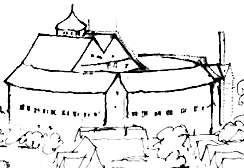
The second Globe, from Hollar's 1638 'Long View of Southwark'.

So one has to wonder who Sam might be. Sam was an American tourist, who visited London, and being (like many American tourists) a fan of William Shakespeare (but a lot smarter than the apocryphal American tourist who thought Bill was a clever dude because he used all those quotes...) went to see the monument where the Globe Theatre had been. He was shocked to find there wasn't one, only a grubby marker.

The New York Times:
On his first visit to London in 1949, he had sought traces of the original theater and was astonished to find only a blackened plaque on an unused brewery.

He decided to do something about it. He was Sam Wanamaker, actor, director, and clearly a visionary. The NY Times again:
He found this neglect inexplicable, and in 1970 launched the Shakespeare Globe Trust, later obtaining the building site and necessary permissions despite a hostile local council. He siphoned his earnings as actor and director into the project, undismayed by the skepticism of his British colleagues.

The world has another Globe in it, where it should be - on the south side (the better side) of the Thames. And now there's a marker there for Sam, voted for by 'the people'.

Sam's spot. James.

Shakespeare's Globe is a magnificent piece of experimental archaeology; one of the most critical sites for the understanding of humanity on the planet, and a bargain day out for a tourist in London - with, if you time it right, a gloss of culture and art and history over a ribald, rattling good evening out and tall tales and swordfights enough for anyone. Not to mention patter enough to knock a rapper.

From Wiki:
While many had said that the Globe reconstruction was impossible to achieve, he persevered for over twenty years, and eventually a new Globe theatre was built according to a design based on the research of historical advisor John Orrell.
Shakespeare's Globe at night, 2008. James.

I'm no ardent fan of Shakespeare; the shadow he casts over English is too large too allow any debate, not a territory I like; but he has a number of things going for him that don't usually make the list. He saw, like many of his time, spelling as a convenience, not a rule, and stretched and kicked-wider English to the extent he is the single most quoted author in the language. (Most people would think of the great declamations, but in fact most of us use will a Shakespeare quote a day without even realising. He is in the very warp and weft of our language.) His spelling is so appealing to a poor speller like me right down to not even spelling his name consistently in the few of his signatures we have. (A fascinating insight to them here.)

'Why are we waiting?' Groundings (And band) pre-performance. James.

We have visited the Globe on many occasions; in fact it was a given stop on our return to the UK last year (and some of the pics are from then - and a great evening out with friends and ex- colleagues Xanthe and Nick) and we have been lucky enough to 'introduce' many friends and family to this theatre.

It would be simplistic to assume that what you get is theatre in Shakespeare's day. It is not, and cannot be; but it is as live as Shakespeare's theatre must have been, with a passing jet airliner or incautious move by a 'groundling' worked into the day's performance by the cast, and theatre where the audience are integral to the story. It is as close as we can get, within reason.

Take a bow. James.

Shakespeare obviously did not live to see the hold his plays would have on the world. Sadly Sam Wanamaker didn't live to see the new Globe completed, either, but I'd hope he realised what a tremendous achievement it is.

Even it's making is of note. It's the first thatched building allowed in London since the Great Fire (for which, of course, there was already a monument in 1970...) and the first thatched building in London to have a sprinkler system fitted - on the outside. But most important of all, it's heart is of English oak - a wooden wall of art.


James

Thursday, June 19, 2008

Tivoli's Pantomime theatre

After over a month's travel, it was our last night in Denmark and on the Continent; and it was a good one, at the Tivoli Gardens. One of the core parts of the Tivoli is the theatres and stages, and particularly, the Pantomime theatre.

This has little or nothing to do with the fine old tradition of British Panto, but has its roots in the in the Commedia del Arte tradition, including the portfolio of stock characters: Harlequin, Colombina and Pierrot, who have a reputation in mainstream life. Visiting Tivoli, we made sure we took in one of the two nightly performances, and here's a few highlights...


Pratfalls and slapstick (top) and the dance of Harlequin and Colombina.


She defies her father, who wishes to match her to Il Capitino (below).


Pierrot, the servant, is well meaning but clumsy and disastrous - a pistol provides endless comic possibilities...


All of which the kids enjoy...


...and at the end, the stage is hidden away by the amazing screen based on a peacock's fan tail.


And that's just the centre of a marvellous open air stage (below). We were reminded of London's Globe Theatre, in its importance as a historic, open venue. (Bev: and in the sheer delight with which the show was greeted by the locals and tourists alike. I enjoyed seeing the Danes in front of us HOOT with laughter when the fop minced on stage and fell over Pierrot).


We thought it a wonderful entertainment, and we enjoyed it immensely, even the (few) bits in Danish. And it is presented in two differing performances most nights at the Gardens, throughout the open season. There will be more about Tivoli Gardens in the next post - so stay tuned!

James